By Kevin Palmer
Registered Professional Marketing (RPM) | Chairman, Canadian Institute of Marketing
CEO, Palmer Creative Group Inc. | 30+ Years Transforming B2B Sales & Marketing
A comprehensive investigation into the silent crisis destroying sales productivity across North American businesses
Thunder Bay – Business – I’ve spent 30 years watching businesses hemorrhage revenue, and the pattern is always the same. They hire talented salespeople, set aggressive targets, provide product training, and then… nothing. No content.
No automation. No marketing systems. Just raw human effort trying to overcome systemic inefficiency.
This isn’t about lazy salespeople or bad products. This is about a fundamental structural failure in how North American businesses approach revenue generation.
And it’s costing us trillions.
The Documentary Evidence: What I’ve Witnessed
Over three decades consulting with hundreds of businesses across manufacturing, telecommunications, technology, and professional services, I’ve documented the same five pain points destroying sales effectiveness. These aren’t theories—they’re observations from the front lines of Canadian and American commerce.
Crisis #1: The Knowledge Consistency Catastrophe
Walk into any company with a 10-person sales team, and you’ll find:
- 3 top performers who understand the value proposition, articulate ROI clearly, and handle objections brilliantly
- 4 average performers who sometimes get it right, often get it wrong, and wonder why they can’t match the top performers
- 3 struggling performers who are good people working hard but presenting inconsistent, often confused messages to prospects
The Mathematics of Inconsistency
If 70% of your sales team delivers mediocre-to-poor presentations because they lack tools to match your top performers, you’re operating at 30-40% of potential revenue capacity. That’s not a training problem. That’s a systems problem.
Why This Happens: Companies expect salespeople to memorize complex product information, understand technical specifications, articulate value propositions, handle objections, and deliver consistent messaging—all from memory, all under pressure, all with perfect execution.
That’s not a job description. That’s a superhuman requirement.
Crisis #2: The Time Allocation Disaster
I’ve analyzed the daily activities of hundreds of B2B sales professionals. Here’s what the average sales rep’s day actually looks like:
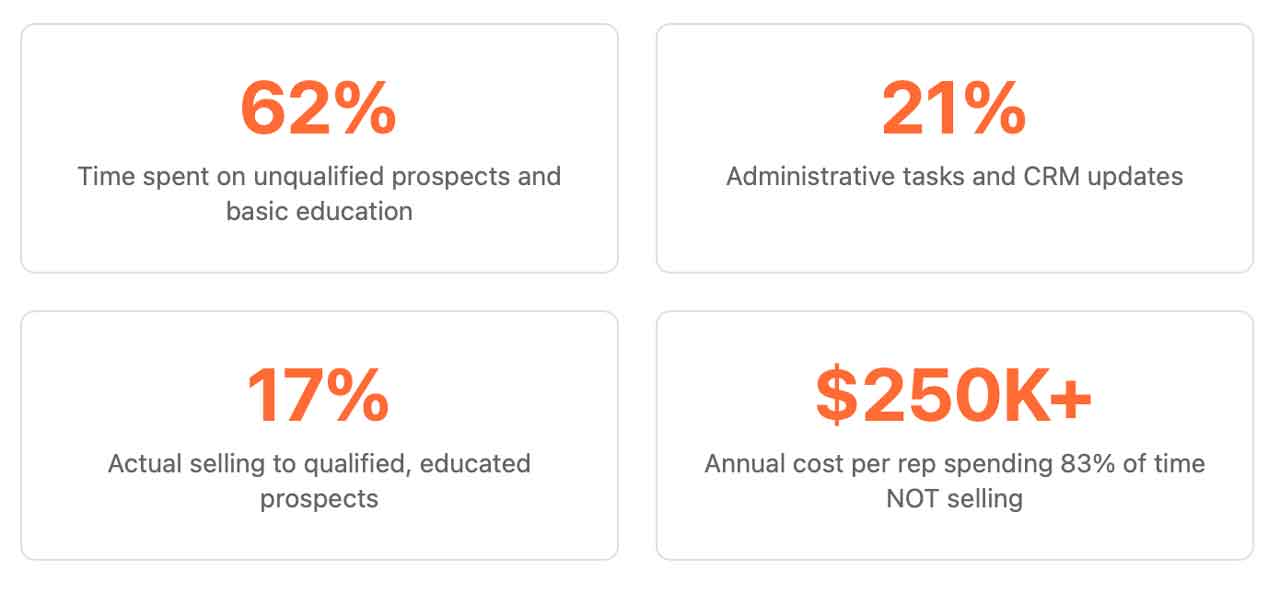
Let that sink in. You’re paying professional salespeople $80,000-$150,000+ annually to spend 17% of their time actually selling.
📋 Real Example: Mid-Market Manufacturing Company
Company: Industrial equipment manufacturer, 12 sales reps, $18M revenue
Challenge: Sales team spending 40+ hours weekly explaining basic product features to unqualified prospects
Analysis: 12 reps × 40 hours × 48 weeks = 23,040 hours annually on basic education
Cost: At $75/hour fully loaded cost, that’s $1,728,000 spent on work that could be automated
Opportunity Cost: Those 23,040 hours could generate 4,608 qualified sales conversations at company’s 25% close rate = $4.5M additional revenue
This company was spending $1.7 million to prevent $4.5 million in revenue. And they’re not unique—this pattern repeats across industries.
Crisis #3: The Lead Nurturing Black Hole
Marketing generates leads. Sales receives them. And then… they vanish into a CRM black hole.
— VP Sales, SaaS Company, Toronto
Here’s what I observe in typical companies:
- Day 1-3: Sales rep makes 1-2 contact attempts
- Day 4-10: Maybe one more attempt if rep remembers
- Day 11-30: Lead sits untouched while rep chases “hotter” prospects
- Day 31+: Lead is “dead” and blamed on marketing for poor quality
The truth? That lead wasn’t dead. They just weren’t ready to buy on your timeline. They needed nurturing, education, value demonstration, and consistent engagement. Without marketing systems providing this automatically, leads die from neglect.
Crisis #4: The Complexity Communication Failure
I’ve sat through hundreds of sales presentations. The pattern is depressingly consistent:
Minute 1-5: Sales rep talks. Prospect nods politely.
Minute 6-10: Rep explains technical details. Prospect’s eyes glaze over.
Minute 11-15: Rep realizes prospect is lost. Tries to backtrack.
Minute 16-20: Prospect asks “how much?” because they don’t understand value.
Minute 21+: Price objection, stalling, “let me think about it.”
The Clarity-Conversion Correlation
When prospects clearly understand your solution and its value, conversion rates run 40-50%. When they’re confused, conversion drops to 12-18%. The difference isn’t your product or price—it’s clarity of communication.
Complex B2B solutions require visual demonstration, customer examples, ROI calculations, implementation timelines, and proof. Expecting salespeople to verbally communicate this in a pressure-filled sales environment is unrealistic. Yet that’s exactly what companies demand.
What Actually Happens:
Technical details are explained poorly or incompletely
Value proposition gets lost in feature discussions
Prospects can’t visualize the solution or its impact
ROI is claimed but not demonstrated
Implementation seems risky because process isn’t clear
Prospects default to “no decision” or choose simpler (inferior) alternatives
Crisis #5: The Scalability Ceiling
Every growing company eventually hits the same wall: Revenue growth becomes linear with headcount.
Want to double revenue? Double your sales team. Want to enter a new market? Hire local reps. Want to serve more customers? Add more bodies. This isn’t business growth—it’s human multiplication.
📊 The Growth Ceiling: Real Numbers
Traditional Sales Model:
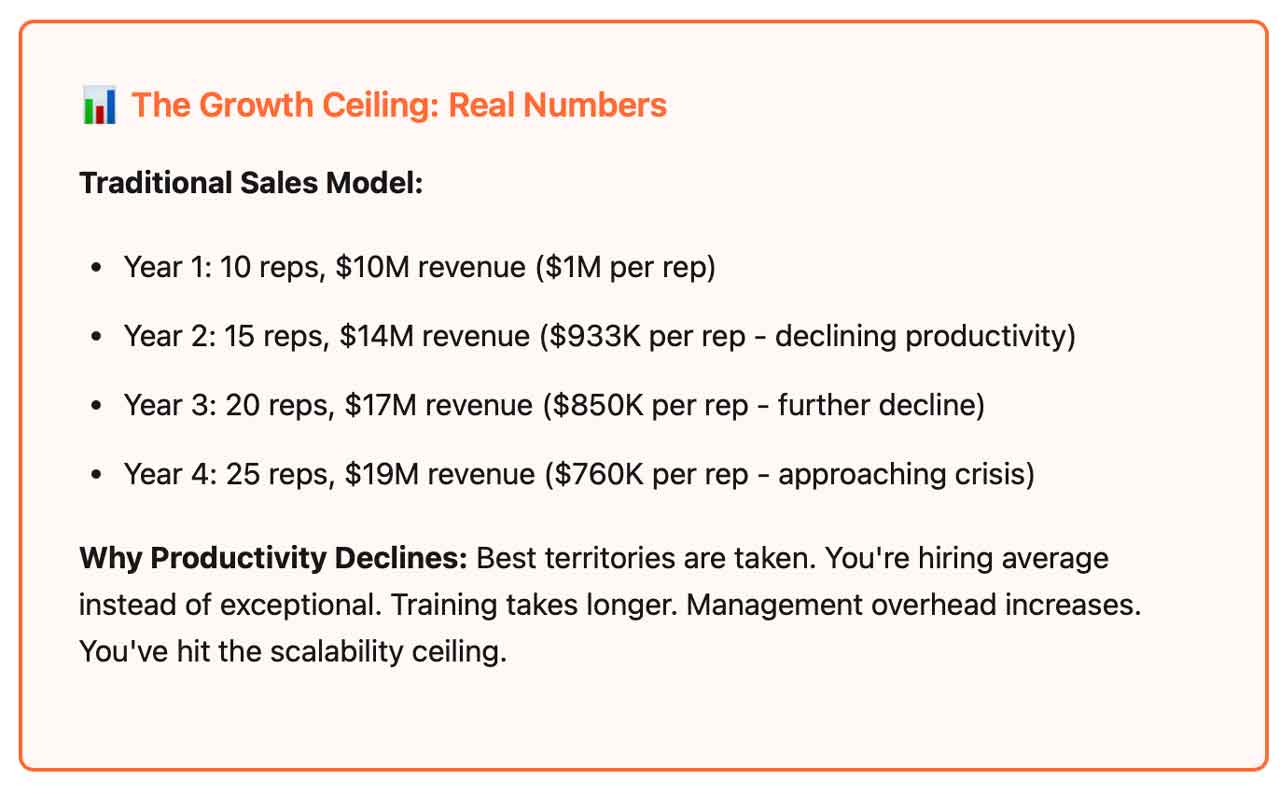
Why Productivity Declines: Best territories are taken. You’re hiring average instead of exceptional. Training takes longer. Management overhead increases. You’ve hit the scalability ceiling.
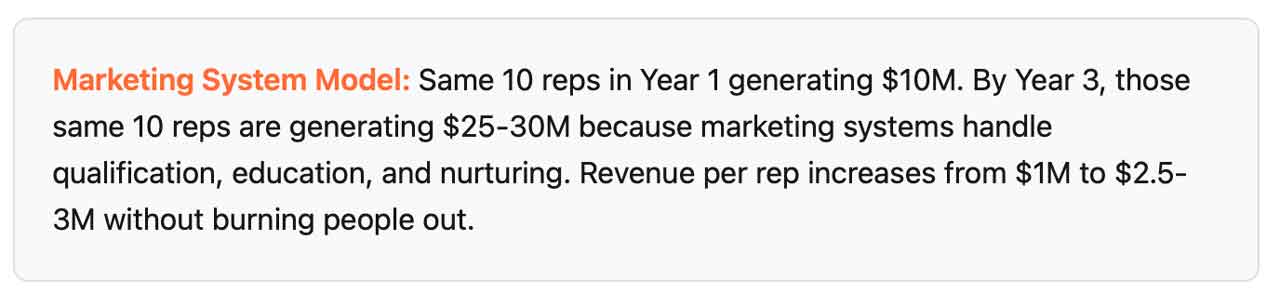
Meanwhile, companies with robust marketing systems supporting their sales teams achieve exponential growth because their capacity isn’t limited by human hours:
Marketing System Model: Same 10 reps in Year 1 generating $10M. By Year 3, those same 10 reps are generating $25-30M because marketing systems handle qualification, education, and nurturing. Revenue per rep increases from $1M to $2.5-3M without burning people out.
The Root Cause: A Fundamental Business Philosophy Error
After analyzing hundreds of companies, I’ve identified why this problem persists: Businesses treat sales as a human function instead of a system function.
Here’s the flawed logic I encounter constantly:
“We need more sales, so we need more salespeople. Sales is about relationships and human connection. You can’t automate sales.”
This thinking is 30 years outdated. Modern sales isn’t about replacing humans—it’s about amplifying human effectiveness through systems.
Think about it this way: Would you hire a construction crew but refuse to give them power tools because “real craftsmen use hand tools”? Would you hire accountants but forbid them from using Excel because “real accountants do math by hand”?
Of course not. Yet businesses do exactly this with sales teams. They hire talented people and then deprive them of the tools that would multiply their effectiveness.
The Solution Framework: What Actually Works
In the past decade, I’ve helped implement marketing systems that transformed struggling sales organizations into revenue machines. The pattern that works is consistent:
Component #1: Scalable Knowledge Transfer
Your top performers have knowledge in their heads. You need that knowledge systematized and deployed at scale. Professional video content, interactive demos, and visual explainers capture your best messaging and make it available 24/7 to unlimited prospects.
Impact: New reps become productive in 3-4 weeks instead of 4-6 months. That’s 4 months of additional revenue per hire. For a 10-person team with 30% annual turnover, that’s 12 months of recovered productivity annually.

Component #2: Automated Qualification Systems
Stop wasting expensive sales time on education and qualification. Marketing systems pre-educate prospects, answer common questions, demonstrate value, and surface buying signals before sales gets involved.
The Math of Qualification
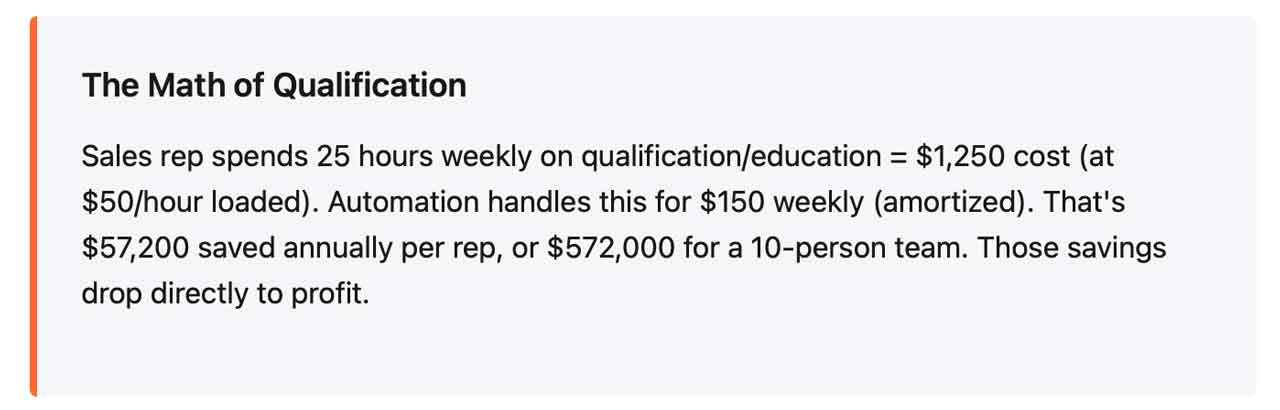
Sales rep spends 25 hours weekly on qualification/education = $1,250 cost (at $50/hour loaded). Automation handles this for $150 weekly (amortized). That’s $57,200 saved annually per rep, or $572,000 for a 10-person team. Those savings drop directly to profit.
Component #3: Systematic Lead Nurturing
Automated sequences that deliver value, build trust, and move prospects through the buying journey without manual effort. Your CRM becomes a revenue asset instead of a lead graveyard.
Component #4: Visual Value Communication
Complex solutions explained through professional video, animation, interactive demos, and customer case studies. Prospects understand your value before sales conversations begin.
Conversion Impact: Clear value communication drives conversion rates from 15-20% to 40-50%. On $10M revenue, that’s the difference between $10M and $20-25M with the same sales team.
Component #5: Exponential Scaling Architecture
Systems that work 24/7, serve unlimited prospects simultaneously, and expand into new markets without adding headcount. Your capacity becomes infinite instead of human-limited.
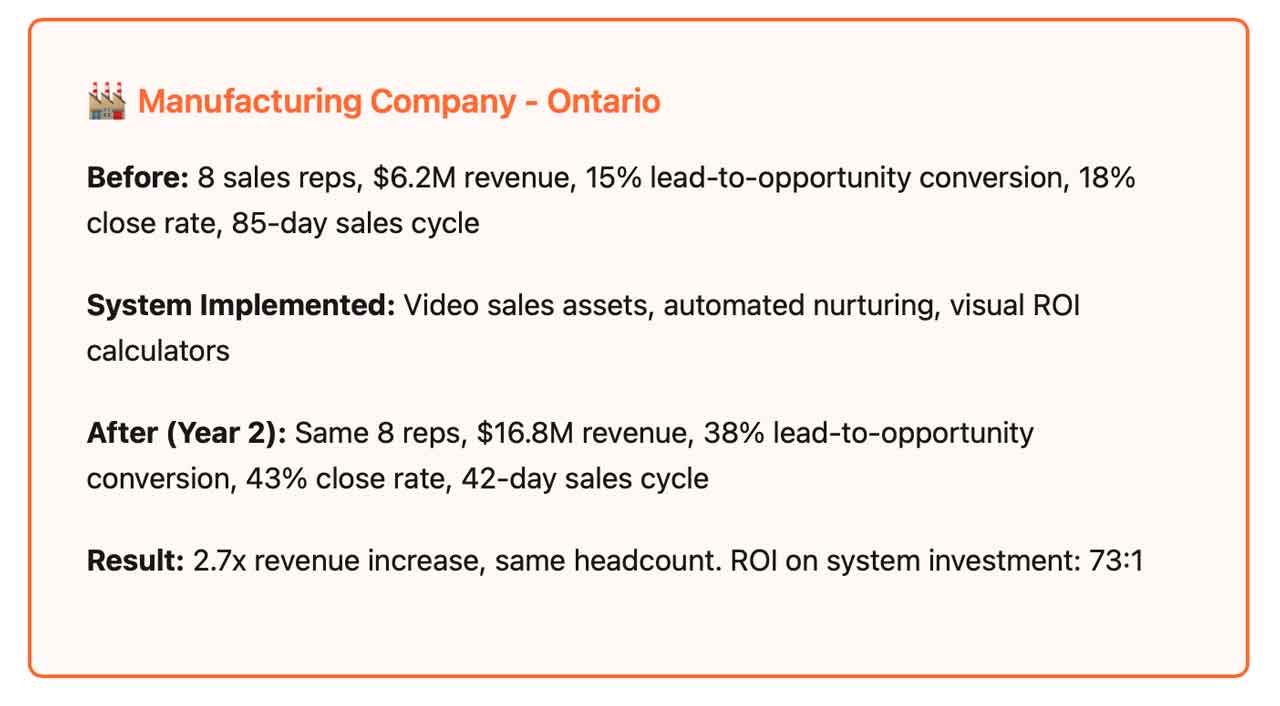
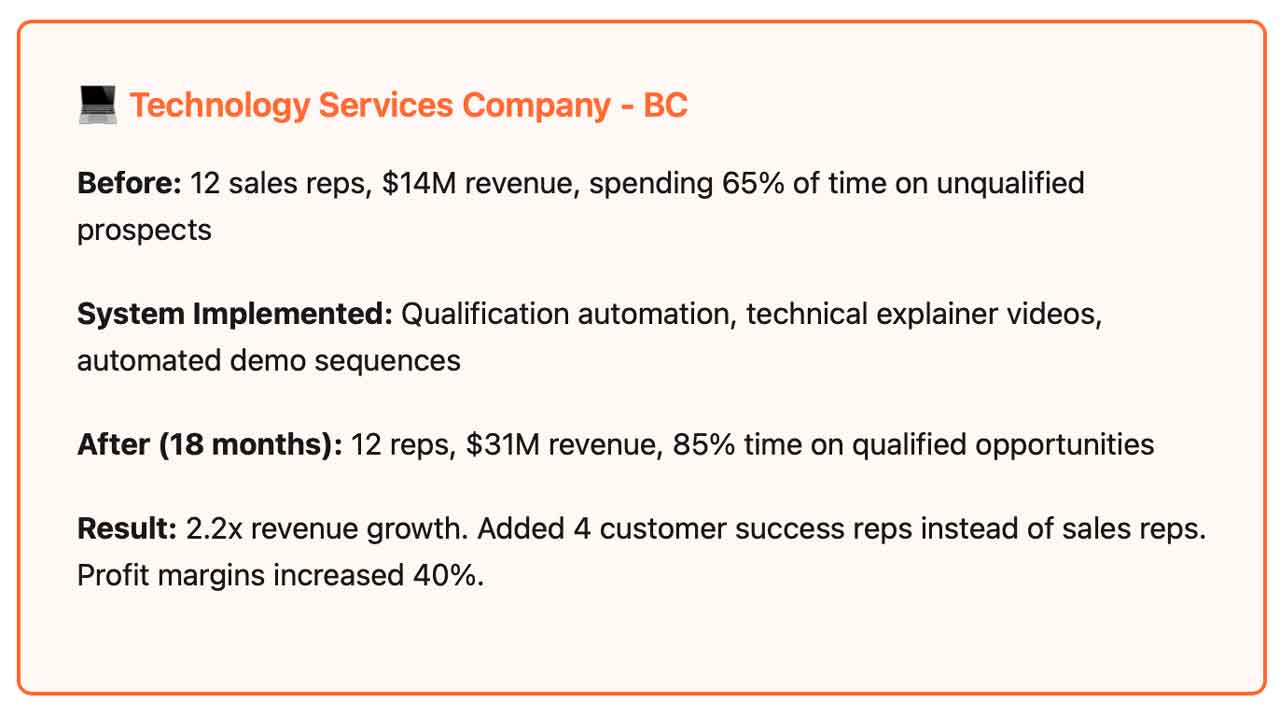
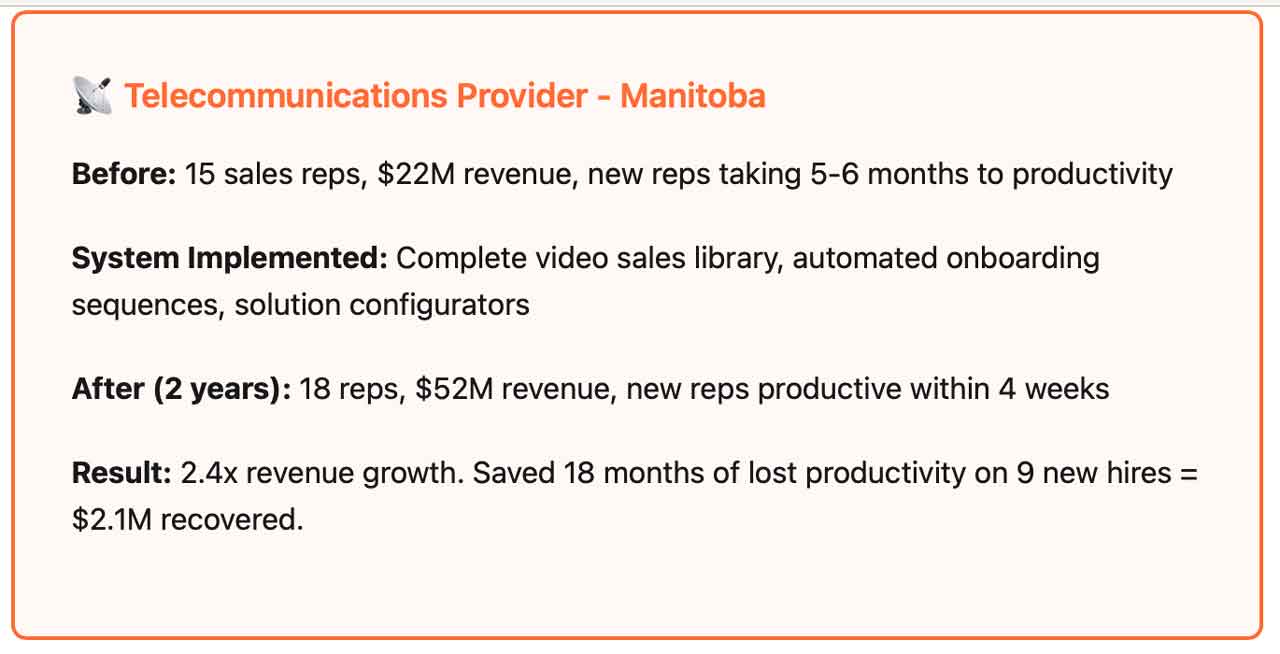
The Evidence: Before & After Transformations
I document every implementation meticulously. Here are real results from the past 5 years:
The Counter-Arguments (And Why They’re Wrong)
Every time I present this research, I hear the same objections. Let me address them directly:
“But sales is about relationships. You can’t automate relationships.”
My Response: Correct. You can’t automate relationships. But you can automate education, qualification, and value demonstration so that when humans have relationship conversations, they’re talking to qualified prospects who already understand and appreciate your value. That’s not replacing relationships—that’s making them more effective.
“Our business is different. Our solutions are too complex for automated systems.”
My Response: I’ve heard this in every industry. And it’s always wrong. The more complex your solution, the more you need visual systems to explain it. Your salespeople aren’t superhuman—they struggle with complexity too. Systems make complexity understandable.
“We tried marketing automation. It didn’t work.”
My Response: You tried email automation sending generic messages. That’s not a marketing system—that’s spam automation. Effective systems provide genuine value, educate meaningfully, and guide prospects intelligently. There’s a massive difference.
“This is too expensive. We can’t afford it.”
My Response: You can’t afford not to do it. You’re already paying for inefficiency—62% of sales time wasted, 50% of leads dying, 4-6 month rep ramp-up, 15-20% conversion rates. That inefficiency costs far more than any system implementation. The question isn’t cost—it’s ROI. And the ROI is typically 30:1 to 100:1 in the first year.
The Path Forward: What Canadian Business Leaders Must Do
As Chairman of the Canadian Institute of Marketing, I’ve spent considerable time discussing this crisis with business leaders, marketing professionals, and sales executives across Canada. The consensus is clear: We’re at an inflection point.
Companies that continue operating with 1990s-era sales methodology will be outcompeted by organizations that embrace systems-supported selling. This isn’t future speculation—it’s happening now.
The Competitive Reality
Your competitors are implementing these systems. When they can convert leads at 40% while you convert at 18%, when they close deals in 35 days while yours take 80, when they generate $2.5M per rep while you generate $900K—you don’t have a sales problem. You have an existential business problem.
What This Means For You
If you’re a CEO or Business Owner: Stop thinking about sales as just hiring more people. Start thinking about building a revenue generation system. The businesses that survive the next decade won’t be the ones with the most salespeople—they’ll be the ones with the most effective sales systems.
If you’re a VP Sales: Stop fighting for more headcount. Start fighting for better systems. Your team is working 60-hour weeks because they lack tools, not because they lack motivation. Give them leverage.
If you’re a Marketing Leader: Stop accepting blame for “low-quality leads.” The leads aren’t low-quality—they’re under-nurtured. Build the systems that transform marketing leads into sales opportunities.
If you’re a Sales Professional: Demand better tools. You’re not a superhuman memory bank. You’re a professional who deserves professional systems. Companies that won’t invest in supporting your success don’t deserve your talent.
Final Observations From Three Decades in the Trenches
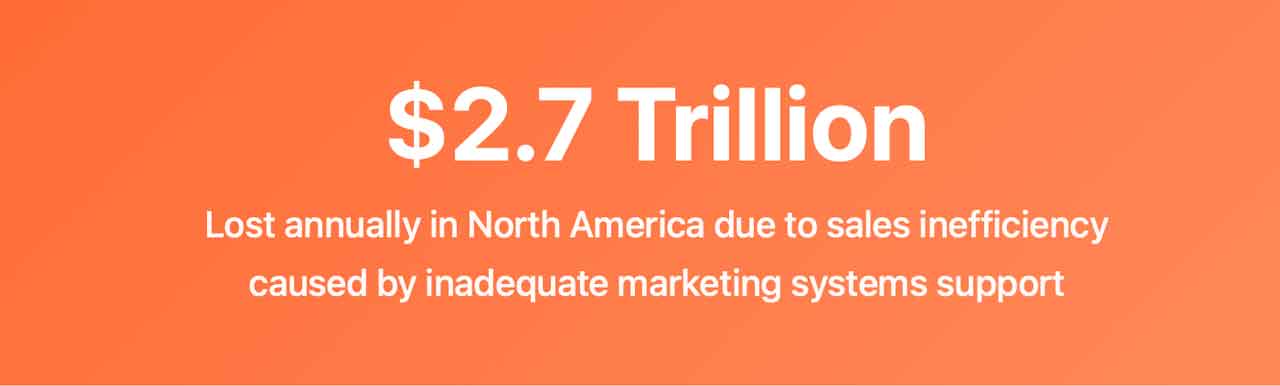
I’ve built Palmer Creative Group on one fundamental belief: Human talent amplified by intelligent systems beats raw human effort every time.The $2.7 trillion we’re losing annually to sales inefficiency isn’t fate—it’s choice. Every day that businesses operate without proper marketing systems supporting their sales teams is a day of choosing inefficiency over effectiveness.The technology exists. The methodologies are proven. The ROI is undeniable. What’s missing is leadership willing to challenge the outdated belief that sales success comes only from hiring more people and working them harder.We can do better. We must do better. Our businesses, our employees, and our economy deserve better.
The question isn’t whether to implement marketing systems supporting your sales team. The question is how much longer you’ll allow your business to operate at 30-40% of its revenue potential.