
Canadian SMEs face a tougher online environment than most owners realize. The good news: Google has shifted the rules in their favor
By Serhii Dovzhenko, SEO Specialist, Vancouver
Running a small business in Vancouver is expensive enough without losing customers to a competitor in New Jersey. But that’s exactly what’s been happening, quietly, for years – and most local owners don’t realize it.
Canada has roughly 1.3 million employer businesses. Nearly all of them – 99.8% – are small or medium-sized. In British Columbia, tens of thousands of micro-businesses are operating in one of the most cost-pressured environments in the country, where commercial rents are steep, the middle class is being squeezed, and first-year business failure rates sit at 21.5%. Half of all new businesses don’t survive five years. In that context, every customer acquisition channel counts. Losing them to algorithmic invisibility is a problem that’s entirely solvable.
The invisibility problem
Here’s a number worth sitting with: 78% of Canadian small businesses have a website. That sounds reasonable until you look at the smallest firms – those with four or fewer employees – where the figure drops to 70%. And having a website, of course, is just the floor. A site that isn’t indexed, isn’t mobile-friendly, and has never been claimed on Google isn’t doing much for anyone.
Meanwhile, as of mid-2025, 12.2% of Canadian businesses are using AI to deliver services or produce goods. That gap – between businesses actively investing in digital infrastructure and those still relying on foot traffic and word of mouth – is widening fast. The ones at the bottom aren’t just behind. They’re actively funneling potential customers toward whoever shows up on page one.
The American problem
Google controls roughly 89.6% of Canadian search traffic. For years, Canadian sites benefited from a degree of geographic protection – Google’s country-code domain system gave local results a natural advantage. That advantage has largely disappeared. U.S. companies, with their massive ad budgets, globally sourced backlinks, and armies of content writers, now compete directly on Canadian commercial searches.
Canadian consumers prefer buying locally – to avoid currency exchange, tariffs, and shipping costs. But the search results they see are full of American businesses.
This creates a real frustration for buyers and a real problem for sellers. The consumer intent is there. The local supply exists. The gap is visibility.
Google’s 2024 update changed the game
In August 2024, Google pushed one of its most significant algorithm updates in years – a deliberate response to years of search results being gamed by mass-produced, SEO-stuffed content. The update explicitly rewarded smaller, independent sites that demonstrate genuine local expertise, first-hand experience, and real-world credibility.
For a well-run Vancouver business, this is a meaningful shift. Google’s local search results are determined by three factors: proximity, relevance, and prominence. A local plumber with a well-maintained Google Business Profile, consistent directory listings, and genuine customer reviews can now outrank a national chain on neighborhood searches. That wasn’t always true.
Reviews are not optional
A lot of business owners avoid engaging with their online reputation – either because they’re too busy, or because they’re afraid of negative feedback. Both are understandable. Neither is a good strategy.
77% of consumers read reviews before visiting a local business. More pointedly: 53% won’t even consider a business with an average rating below 4.0 stars. In competitive Vancouver markets, review attacks from rivals or disgruntled ex-employees are a real phenomenon. The response to that isn’t to ignore the problem. It’s to build a consistent review generation process, respond professionally to criticism, and flag genuinely defamatory content through Google’s legal channels.
The foundation: citations, profiles, consistency
Around 60% of Google searches now end without the user clicking any link at all – they get their answer directly from Google’s interface, usually from a Google Business Profile. That makes your GBP not just an asset, but frequently the first and last thing a potential customer sees. It needs to be claimed, fully completed, and regularly updated.
Beyond Google, businesses should be listed on Yelp.ca, Yellowpages.ca, and Canada411.ca at minimum. What matters most across all of them is consistency: the same business name, address, and phone number everywhere. Search engines use that matching data to verify that a business is legitimate and operational. Inconsistencies – even minor ones, like “St.” versus “Street” – create friction in that verification process.
Paid ads: the accelerant
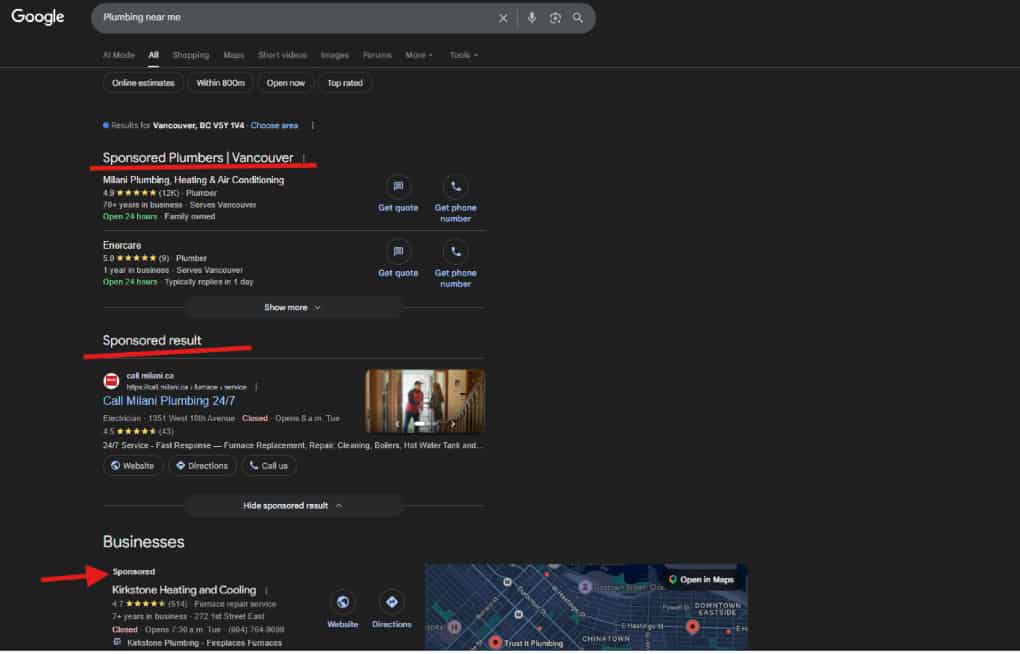
Organic search is a long game. It builds compounding value, but it takes time. Paid advertising – Google PPC, targeted local campaigns – provides immediate, measurable customer acquisition while the organic foundation is being built. Businesses that run online paid ads report cumulative growth of around 39% over two years compared to those that don’t. The two approaches aren’t in competition. They work best together.
The era of free reach on social media is effectively over. Algorithmic throttling on every major platform means organic posts reach a fraction of your followers. Social media still has a role, but as a paid channel – not a free one.
The bottom line
The digital environment for Vancouver small businesses is more competitive than it’s ever been. But it’s also more tilted toward local operators than it has been in years, thanks to Google’s 2024 updates and the growing consumer preference for domestic businesses. The businesses that will struggle are those that treat digital presence as a one-time setup task. The ones that will grow are those that treat it as ongoing infrastructure – as fundamental as their lease or their payroll.
A website, a clean Google Business Profile, consistent directory listings, a steady stream of reviews, and a modest paid advertising budget aren’t marketing luxuries. They’re the table stakes for being found. For many owners, the practical starting point is working with a local SEO agency that understands the Vancouver market specifically – not a generic national service.
Serhii Dovzhenko is an SEO specialist based in Vancouver. This article reflects independent analysis of the Canadian small business digital landscape.