Update #3: Five charged after Eabametoong First Nation assault investigation becomes homicide case
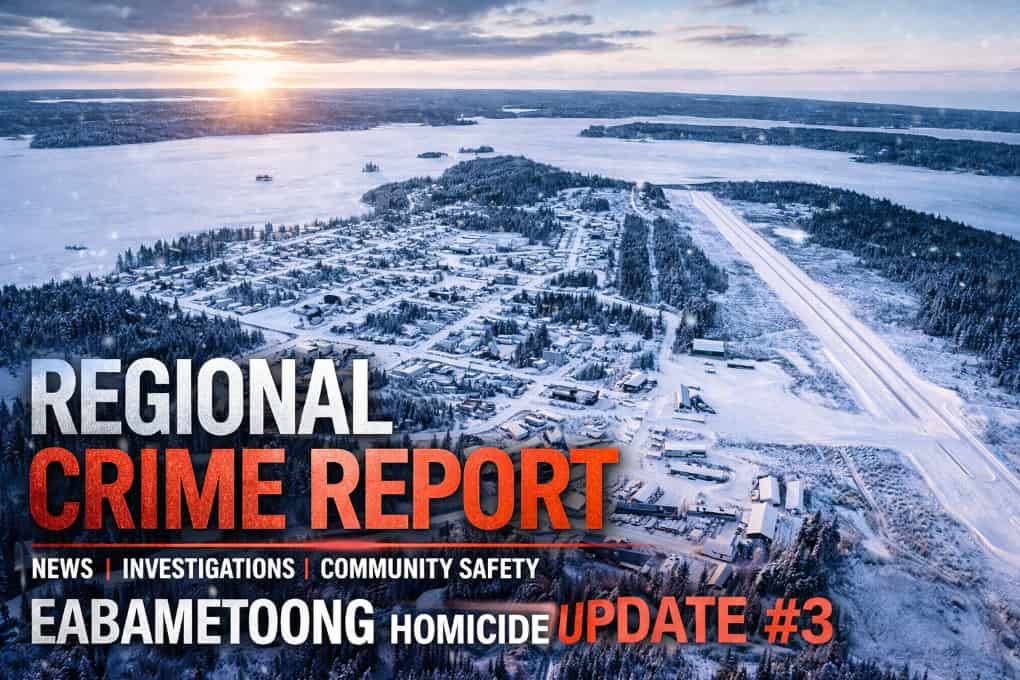
EABAMETOONG FIRST NATION — A violent assault investigation in Eabametoong First Nation has now become a homicide case after one of two injured people died in hospital. Ontario Provincial Police and Nishnawbe Aski Police Service say five people from the community have been arrested and charged.
The case remains a major investigation in Northwestern Ontario, involving NAPS, the OPP Criminal Investigation Branch, forensic teams and the Office of the Chief Coroner.
One victim dies, five accused now facing murder and assault charges
Police say officers with the Nishnawbe Aski Police Service Eabametoong detachment responded at about 3:35 a.m. on Sunday, March 29, to reports of an assault on Albany River Crescent.
Two people were found with life-threatening injuries and were airlifted to hospital.
On Tuesday, March 31, police say one of the victims, a 33-year-old man from Eabametoong First Nation, died of his injuries.
As a result of the investigation, five people from Eabametoong First Nation have each been charged with second-degree murder and aggravated assault.
Police have identified the adult accused as Edgar Moonias, 47, Trayvon Wabano, 18, and Samson Wabano, 19.
Two additional accused, ages 17 and 15, cannot be identified under the Youth Criminal Justice Act.
Edgar Moonias remains in custody for a bail hearing and is scheduled to appear in the Ontario Court of Justice in Thunder Bay on Thursday, April 2, 2026.
The other four accused were remanded into custody and are scheduled to appear in the Ontario Court of Justice in Thunder Bay on Tuesday, April 14, 2026.
All charges have yet to be proven in court. All accused are presumed innocent unless proven guilty.
Major case investigation continues
Police say the OPP North West Region Crime Unit and the NAPS Crime Unit are continuing the investigation under the direction of the OPP Criminal Investigation Branch, with assistance from the Office of the Chief Coroner and the Ontario Forensic Pathology Service.
Further support is being provided by OPP Forensic Identification Services and NAPS Forensic Identification Services.
Police also thanked the Chief and Council of Eabametoong First Nation, along with community members, for their support as the investigation continues.
What the charges mean under Canadian law
Second-degree murder is among the most serious offences in the Criminal Code. In practical terms, it applies to murder that is not planned and deliberate first-degree murder, though the exact legal classification depends on the facts alleged by police and later proven in court. For an adult convicted of second-degree murder, the sentence is automatically life imprisonment.
A judge then sets parole ineligibility at between 10 and 25 years.
The aggravated assault charge under section 268 of the Criminal Code applies where a person is alleged to have wounded, maimed, disfigured or endangered the life of another person. It is an indictable offence carrying a maximum sentence of 14 years in prison.
For the two youth accused, the Youth Criminal Justice Act also applies. That means their identities are protected by law, and if there are convictions, youth sentencing provisions would generally govern unless the Crown seeks an adult sentence and the court agrees.
Why this matters in Northwestern Ontario
The case underscores the realities of serious violent-crime investigations in remote First Nations. When major assaults or homicides happen in fly-in communities, the response can quickly involve emergency air transport, specialized investigators, forensic teams and court appearances far from home in Thunder Bay.
For Eabametoong and other northern communities, that can add another layer of strain for families, witnesses and local leadership already dealing with the impact of a serious crime.
Public asked to come forward
Anyone with information about the investigation is asked to contact the OPP at 1-888-310-1122. Anonymous tips can be provided through Crime Stoppers at 1-800-222-8477 or online through Ontario Crime Stoppers.