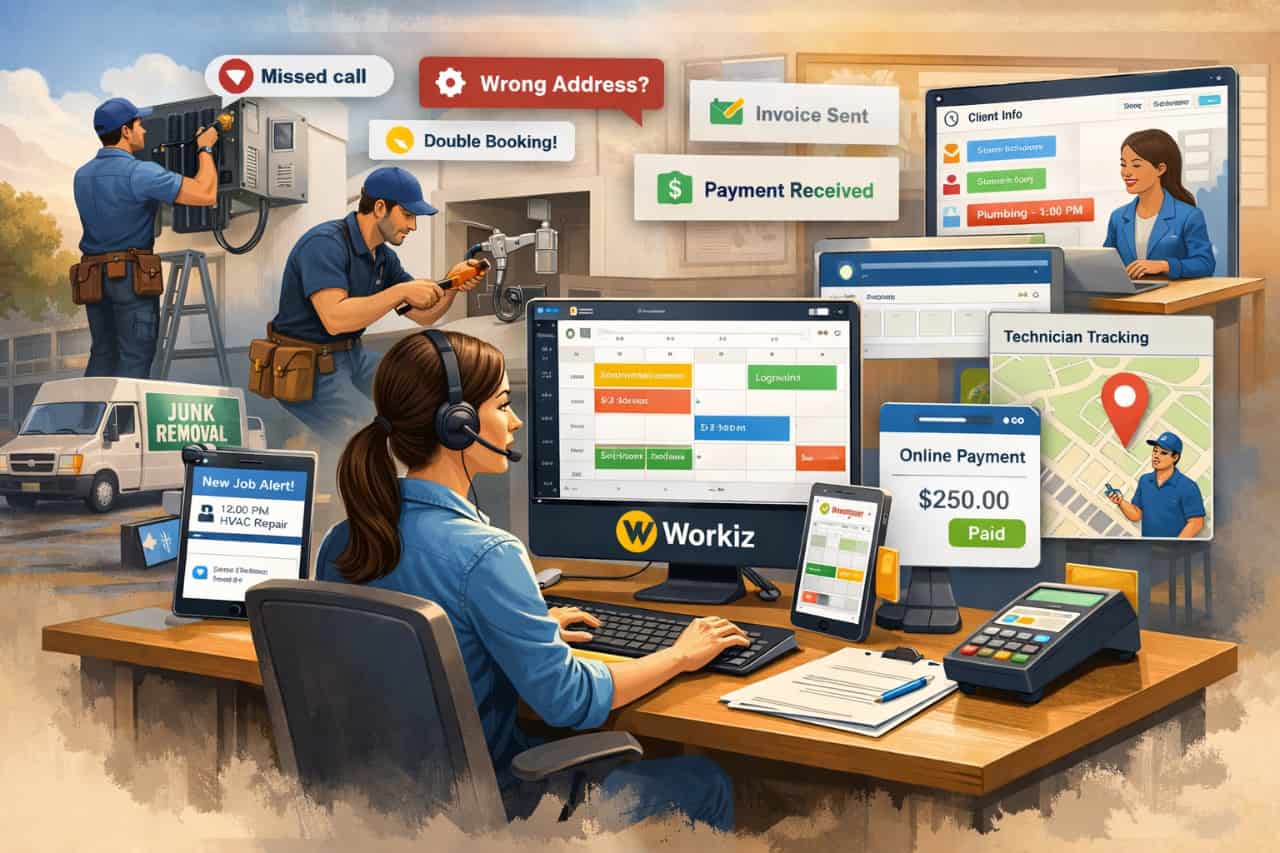
In the field service business, every missed phone call, delayed invoice, wrong address, or double-booked technician can cost money. For companies that work on-site — whether they fix furnaces, repair plumbing, install electrical systems, open locked doors, or haul away junk — the day moves fast. Owners and managers are often trying to juggle customer calls, employee schedules, dispatching, billing, and follow-up all at once.
Workiz.com positions itself as a comprehensive field service management platform built to help service businesses stay organized and efficient. Rather than relying on a patchwork of paper schedules, spreadsheets, text messages, and separate billing tools, Workiz offers a system that brings the moving parts of the business together in one place.
That is where field service management software has become a major part of modern business operations.
The platform is designed to handle the full workflow for companies that send workers into the field. That includes job scheduling, dispatching technicians, creating invoices, taking payments, tracking customers, and helping teams communicate more clearly. In simple terms, Workiz is trying to solve one of the biggest problems for field service operators: too many tasks, too many systems, and not enough time.
For a business owner, time is often the most valuable resource. The more hours spent chasing paperwork or sorting out scheduling mistakes, the fewer hours remain to grow the company, train staff, improve service quality, or win more customers. Software like Workiz aims to reduce that friction.
At its core, Workiz is built around centralization. That matters because many field service businesses do not fail because they lack skilled workers. They struggle because the office side of the operation becomes too chaotic. A plumbing company may have great technicians, but if the office misses calls or sends crews to the wrong location, customer trust starts to erode. An HVAC business may do top-quality work, but if invoices are late and payments are hard to process, cash flow suffers.
Workiz tries to address that by placing the operational tools in one platform. Scheduling is one of the most important of those tools.
In a field service company, scheduling is not just about putting names on a calendar. It involves matching the right technician to the right job, taking travel time into account, handling emergencies, avoiding overlap, and making sure the customer knows when help is coming. If one job takes longer than expected, the rest of the day can quickly go off the rails.
By offering job scheduling in a single system, Workiz is designed to help managers and dispatchers see the full picture. That can make it easier to assign jobs, adjust the schedule when needed, and avoid the confusion that often comes with using separate systems or manual notes.
Dispatching is closely tied to scheduling, and in many service businesses it can be the difference between a smooth day and a costly one. Dispatchers need to know who is available, where each technician is headed, and what job information they need before arriving on site. They also need to communicate quickly when priorities change.
A platform that combines dispatch with customer details and scheduling helps reduce the number of handoffs and misunderstandings. When a technician has the address, job notes, service history, and timing details ready to go, they are in a better position to do the work well and keep the customer informed.
That customer communication piece is especially important in today’s service economy. People expect businesses to respond quickly and clearly. They want to know when a technician is coming, what the service may cost, and how payment will work. They also want professionalism. A company that appears organized tends to inspire more confidence than one that sounds rushed or unsure.
This is where a customer management system can play a major role. Workiz includes customer management tools intended to help businesses keep records together, track past service history, and create a more complete view of each client relationship. That can matter a great deal in repeat-service industries such as HVAC, plumbing, and electrical work, where ongoing maintenance and repeat calls are common.
For example, if a technician can quickly see what work was done at a property in the past, they may be able to diagnose the new issue faster. If the office team can see billing history and previous communications, they can answer questions more efficiently and reduce confusion. Over time, that creates a more professional experience for the customer.
Invoicing and payment processing are another major pain point for field service companies, especially smaller businesses that often face tight cash flow. A completed job does not help the business much if the invoice is delayed or payment takes weeks to collect.
Workiz includes invoicing and payment features that are meant to shorten that gap. The goal is simple: once the job is done, the business should be able to bill quickly and get paid quickly. Faster billing can improve cash flow, reduce back-office work, and lower the risk of unpaid jobs falling through the cracks.
That is particularly important in trades and service industries where businesses may be carrying payroll, fuel costs, vehicle maintenance, supplies, and insurance expenses all at once. A delay in payment from customers can create a ripple effect through the whole operation. Anything that helps reduce administrative lag can strengthen the business.
Another important feature of a platform like Workiz is visibility. Owners of field service businesses often wear many hats. They may manage staff, answer calls, review estimates, deal with customer complaints, and track finances, sometimes all in the same day. Without a strong system, it can be difficult to know what is actually happening across the business at any given moment.
A centralized platform can give business owners a clearer sense of where jobs stand, which technicians are booked, what invoices are outstanding, and where bottlenecks may be developing. That kind of visibility can help with decision-making and long-term planning.
It can also support growth.
Many service companies start small. A founder may begin as a one-person operation with a truck, a phone, and a strong work ethic. Over time, that business may add office support, then a second technician, then a third vehicle, and eventually a larger team. What worked when the company had five jobs a week may stop working when it has fifty.
That is often the point where software becomes less of a luxury and more of a necessity. Processes need to be standardized. Job information needs to be shared quickly and accurately. Customers need consistency. Staff need accountability. A system like Workiz is meant to help businesses make that transition from hustle-driven operations to more structured growth.
The industries Workiz serves reflect the broader field service economy. HVAC, plumbing, electrical, locksmith, and junk removal are all industries where speed, coordination, and communication matter. These are essential services. Customers often call when they have an urgent need: no heat, a leaking pipe, a failed breaker, a lockout, or a pile of unwanted material that has to be removed.
In each of those cases, the customer experience is shaped by more than the technical work itself. It is shaped by how quickly the company answers, how accurately it schedules, how well it communicates, and how easily it handles billing. In other words, operations matter almost as much as skill.
Workiz appears to recognize that reality. Its value proposition is not simply that it helps businesses “go digital.” It is that better operations lead to better service, and better service leads to stronger customer satisfaction.
That connection matters because customer expectations have changed. People are used to digital convenience in nearly every part of life. They expect appointment reminders, fast communication, and easy payment options. A field service business that still runs entirely through paper logs and scattered phone calls may find itself at a disadvantage against competitors that offer a smoother experience.
For service professionals, that does not mean replacing craftsmanship with software. It means supporting craftsmanship with better systems. A good technician still has to diagnose the problem and do the work right. Good software simply helps make sure they arrive on time, know what the job is, and can close out the work properly once it is finished.
Workiz says it serves more than 120,000 service professionals. That number points to something broader happening across the service economy: digital tools are no longer just for large companies with big back offices. Increasingly, they are becoming standard equipment for trade businesses, home service operators, and growing local companies that want to compete in a tighter market.
That trend is likely to continue.
Labour shortages, rising operating costs, and higher customer expectations are all pushing service businesses to look for better ways to manage time and resources. Owners cannot afford wasted trips, missed calls, or invoicing delays. Technicians cannot afford to spend half the day waiting for office callbacks or searching for job details. Customers do not want uncertainty.
In that environment, software platforms like Workiz are part of a larger shift toward efficiency, accountability, and professionalism in the trades and service sectors.
Of course, no software is a magic cure. A platform can improve workflows, but it still depends on how well a company uses it. Training matters. Leadership matters. Clear processes matter. Businesses still need good people, strong communication, and a focus on service. Technology works best when it supports those fundamentals rather than trying to replace them.
Even so, the appeal is clear. For many service businesses, the biggest challenge is not demand. It is managing the flow of work in a way that is profitable and sustainable. A company can have all the phone calls in the world, but if it cannot schedule efficiently, dispatch properly, invoice quickly, and keep customers informed, growth can become a burden instead of a success.
That is the operational gap Workiz is trying to fill.
By combining scheduling, dispatch, invoicing, payment processing, and customer management in one system, the platform is built to help field service businesses reduce friction and stay in control of daily operations. For companies that work in fast-moving, on-site service environments, that kind of structure can make a real difference.
In the end, field service businesses still run on trust. Customers trust that the company will show up, solve the problem, and treat them fairly. Teams trust that the office will keep things organized. Owners trust that the work being done will turn into revenue.
The more clearly a business can connect those pieces, the stronger it becomes.
Workiz is part of a growing class of software tools built around that simple idea: when service companies can manage the business side of the job as well as the technical side, they are better equipped to succeed.