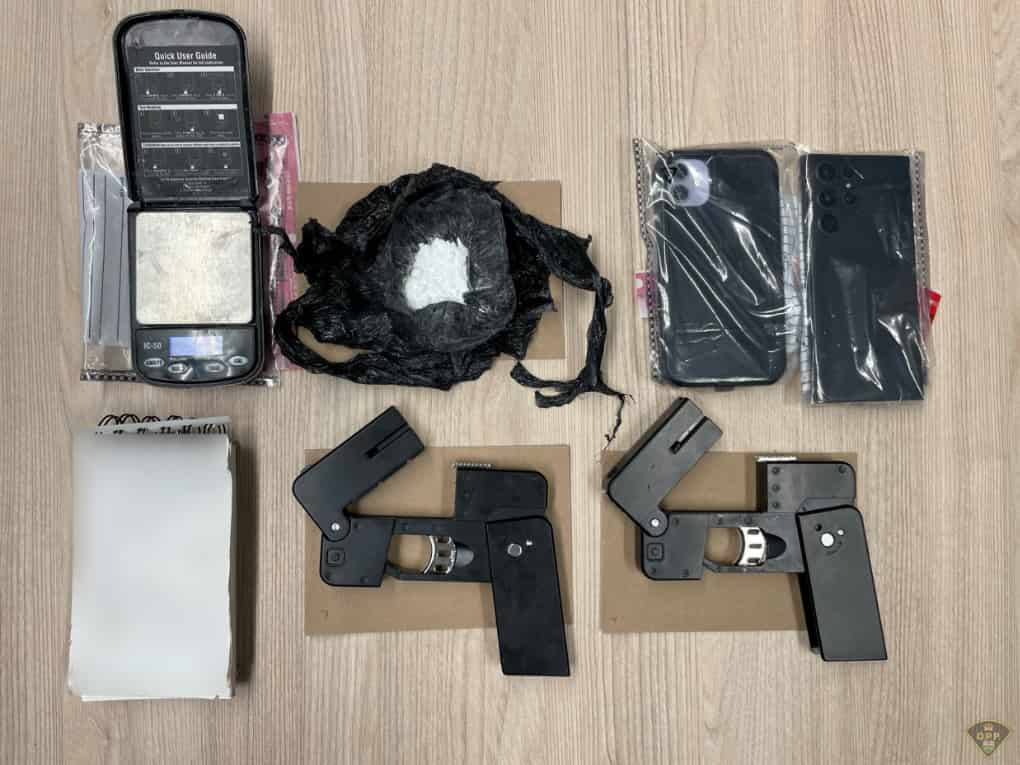
Two handguns seized in Thunder Bay trafficking probe; woman faces firearm and cocaine charges
Thunder Bay – News – A Thunder Bay woman is facing multiple firearm and drug charges after a March trafficking investigation led by the OPP’s Provincial Guns and Gangs Enforcement Team.
Police allege illegal handguns and cocaine were being kept in the city as part of suspected trafficking activity affecting Thunder Bay and surrounding communities.
May Street search warrant leads to seizure of handguns and suspected cocaine
Police say the OPP-led Provincial Guns and Gangs Enforcement Team, working with the Nishnawbe Aski Police Service and Thunder Bay Police Service, began an intelligence-led investigation in March 2026 into alleged drug trafficking in Thunder Bay and nearby communities.
On Tuesday, March 11, investigators, assisted by the Thunder Bay Police Service emergency tactical unit, executed a search warrant on May Street.
Police say officers seized two handguns, about 17 grams of suspected cocaine, two cellphones and a digital scale.
As a result of the investigation, Terry-Lynn Scott, 52, of Thunder Bay, was arrested and charged with two counts of possession of a weapon for a dangerous purpose, two counts of careless storage of a firearm, two counts of knowledge of unauthorized possession of a firearm, two counts of unauthorized possession of a restricted or prohibited firearm, and one count of possession for the purpose of trafficking in cocaine.
The accused was held for a bail hearing and was scheduled to appear in the Ontario Court of Justice in Thunder Bay on Friday, March 20, 2026.
What the firearm charges mean
The charge of possession of a weapon for a dangerous purpose under section 88(1) of the Criminal Code alleges that a person carried or possessed a weapon for a purpose dangerous to the public peace, or for the purpose of committing an offence. It is a hybrid offence, meaning the Crown can elect to proceed by indictment or by summary conviction. The maximum penalty is 10 years in prison if prosecuted by indictment; if prosecuted summarily, the general summary-conviction penalty applies unless another penalty is specified.
The careless storage counts under section 86(1) allege that a firearm was used, carried, handled, transported or stored carelessly, or without reasonable precautions for the safety of others. That offence is also hybrid. On indictment, the maximum penalty is two years for a first offence and five years for a second or subsequent offence; on summary conviction, the general summary penalty applies.
The knowledge of unauthorized possession counts under section 92(1) are more serious because they require the Crown to prove not only possession, but knowledge that the person did not lawfully hold the required licence and, for a restricted or prohibited firearm, the required registration certificate. That offence is indictable only and carries a maximum penalty of 10 years in prison.
The unauthorized-possession counts under section 91(1) allege possession of a firearm without the required licence and, in the case of a restricted or prohibited firearm, the required registration certificate.
That offence is hybrid, with a maximum penalty of five years if prosecuted by indictment, or the general summary-conviction penalty if prosecuted summarily.
What the cocaine trafficking charge means
The drug charge is under section 5(2) of the Controlled Drugs and Substances Act, which makes it an offence to possess a substance for the purpose of trafficking. The act defines “traffic” broadly: it includes selling, giving, transferring, transporting, sending or delivering a substance, and even offering to do so. Cocaine is listed as a Schedule I substance, which places it among the most seriously treated drugs under the act.
Because the allegation involves cocaine, a Schedule I substance, the charge is straight indictable and carries a maximum penalty of life imprisonment. The maximum is not the same as the likely sentence. Actual penalty depends on factors such as the amount of drugs involved, the role of the accused, criminal record, whether the Crown proves a trafficking purpose, and whether aggravating factors are present.
What penalties a judge could impose on conviction
If there were convictions on the firearm counts, a judge would have a wide range of sentencing options depending on which counts resulted in guilt and how the Crown proceeded. On the hybrid counts, that can range up to the summary-conviction maximum of a $5,000 fine, two years less a day in jail, or both, unless a different penalty is specified. On the indictable firearm counts, the exposure rises to five years for section 91(1) and 10 years for sections 88(1) and 92(1).
On the cocaine count, a judge could impose anything from a non-penitentiary sentence to a lengthy prison term, depending on the facts proven in court. Ontario sentencing summaries note that small-amount street-level cocaine trafficking cases can draw sentences in roughly the six-month to two-years-less-a-day range, while substantial possession-for-the-purpose-of-trafficking cases move into multi-year penitentiary terms. Those are only broad guideposts, not rules, and the presence of firearms can significantly increase the seriousness of a case.
A conviction on the cocaine trafficking count can also trigger a mandatory weapons prohibition order under section 109 of the Criminal Code. For a first offence, that generally means at least 10 years without ordinary firearms and a lifetime ban on prohibited or restricted firearms, prohibited devices and prohibited ammunition. Subsequent qualifying convictions can result in a lifetime prohibition on all firearms and related items. Firearms seized as the subject matter of the offence can also be forfeited to the Crown.
Why the case matters in Thunder Bay
Thunder Bay continues to be a focal point for multi-agency guns-and-drugs investigations because it is the region’s largest urban centre and a transportation hub linking communities across Northwestern Ontario.
When police allege cocaine trafficking and illegal handguns in the city, the implications extend beyond one address, touching public safety, addictions, organized crime enforcement and the strain already felt by courts, health care and social services.
Recent OPP reporting has also highlighted Thunder Bay’s role in major organized-crime and drug-trafficking investigations in the Northwest.
Presumption of innocence
The allegations have not been proven in court. Scott is presumed innocent until proven guilty in a court of law.
Anyone with information about illegal firearms or the possession, manufacturing or trafficking of illicit drugs is asked to contact OPP at 1-888-310-1122 or Crime Stoppers anonymously at 1-800-222-8477.