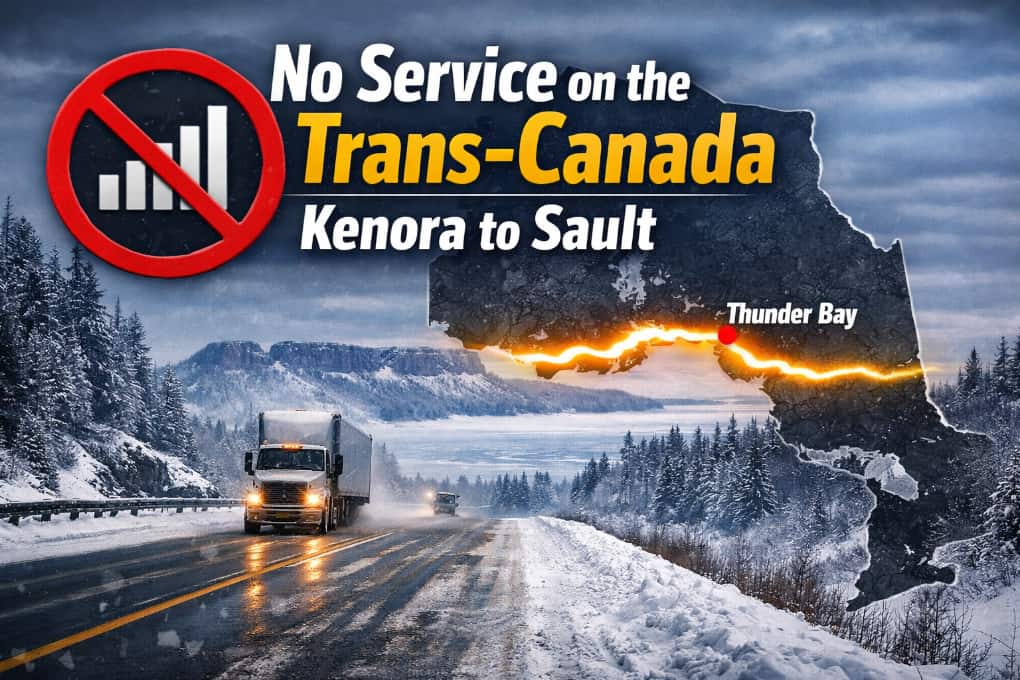
Across Northwestern Ontario, dropped calls and lost data aren’t an annoyance—they’re a risk multiplier
Thunder Bay – Business – From Kenora through Dryden and Ignace, past Thunder Bay and along Lake Superior’s North Shore to Wawa and Sault Ste. Marie, drivers know the routine: calls drop, texts fail, maps freeze, and “SOS only” becomes the most common network you see.
Now to be clear, this is more of a responsibility of the federal government and provincial government more than it is for the wireless providers. It should be taking a broader image of the issue of communications and adding it to supported funding to make it happen.
On the Lake Superior shoreline stretch alone, tourism and travel organizations have publicly flagged repeated trouble spots for connectivity—between Nipigon and Schreiber, Terrace Bay and Marathon, Marathon and White River, White River and Wawa, and Wawa and Sault Ste. Marie.
That’s not a minor tech complaint. It’s a safety issue on highways that can turn deadly in winter—and it’s an economic drag on the corridor communities that rely on steady traffic.
Winter driving is hard enough—now add silence when something goes wrong
Highway 17 and the Highway 11/17 corridor are not “just another drive.” They are long-distance routes with severe winter weather, extended gaps between services, and crash scenes where minutes matter.
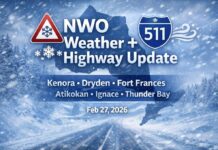
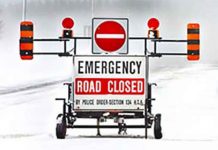
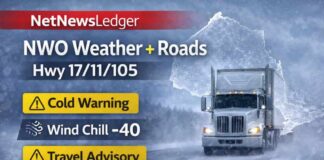
NetNewsLedger recently documented a winter stretch that included multiple fatalities and at least 148 hours of closures from Kenora to Sault Ste. Marie. When the highway is closed—or when a vehicle ends up in the ditch—the ability to call for help, share a location, or get real-time updates can be the difference between a tough wait and a life-threatening situation.
Recently, in a two hour period trying to communicate with a business associate driving from Thunder Bay to Sault Ste Marie, the call was dropped more than ten times. It demonstrates the scope of the problem.
Ontario’s 511 system offers real-time incident and closure information (including a mobile app and audio alerts). But those tools depend on connectivity—exactly what disappears in the dead zones.
“No coverage” also means “no commerce” for the corridor
This isn’t only about travellers. It’s about the economy of Northern Ontario—tourism, supply chains, and small businesses that operate along the Trans-Canada.
A Northern Ontario transportation briefing points to the scale of goods movement and daily trucking in the region—and lists “inadequate mobile phone and data network coverage” among the core barriers holding the system back. For businesses, connectivity gaps translate into:
-
Lost sales and bookings when travellers can’t reliably search, call, or pay.
-
Operational risk for trucking, dispatch, roadside assistance, and time-sensitive deliveries.
-
Reduced competitiveness for communities trying to attract investment, remote work, and tourism spending.
The Thunder Bay Chamber of Commerce has urged the federal government to prioritize cellular build-out for “major transportation highways” as a supply-chain and resilience issue.
Canada can’t claim “connected” when major roads still go dark
Nationally, population coverage can look impressive—while highway coverage tells a different story.
The CRTC reports LTE covers 99.5% of the population, but only 86.6% of major transportation roads and highways. That gap is exactly what Northern Ontario drivers experience: you can be “covered” in town and still be stranded offline between towns.
The CRTC has also funded projects specifically to improve mobile service along major roads, framing it as a public-safety issue. And the CRTC is now working toward standardized, evidence-based mobile coverage reporting—an effort aimed at making gaps harder to hide behind optimistic maps.
This is a national corridor—so treat wireless like national infrastructure
The Trans-Canada Highway is the backbone route across the country. In Northern Ontario it’s also, for many communities, the only practical year-round connection for goods, services, and emergency travel.
If Canada and Ontario can debate (and fund) highway twinning, passing lanes, and bridge work, they can set a clear standard for connectivity too:
1) Make continuous “emergency-capable” coverage mandatory on the Trans-Canada
At minimum, drivers should have reliable ability to place emergency calls and send basic data (location) along the corridor—Kenora to Sault Ste. Marie, and onward.
2) Tie spectrum policy to highway outcomes
Wireless spectrum is public property. Licences and renewals should come with measurable corridor requirements: fill the gaps on Highway 17 and the Highway 11/17 corridor, not just improve in-town speeds.
3) Build towers the way we build roads: planned, powered, and permanent
One of the biggest cost drivers is backhaul and power. Governments can reduce that friction by:
-
prioritizing right-of-way approvals,
-
bundling fibre/backhaul work with transportation projects,
-
and using funding programs to “close gaps” end-to-end, instead of scattered upgrades.
4) Use existing federal tools—specifically the highway language already on the books
Ottawa’s Universal Broadband Fund includes up to $50 million for mobile Internet projects benefiting Indigenous peoples, explicitly including projects “along highways and roads where mobile connectivity is lacking.” That wording matches the Northern Ontario reality—and should be used aggressively for this corridor.
5) Treat satellite-to-phone as backup, not a substitute
The federal government has also advanced a framework for “supplemental mobile coverage by satellite,” intended to supplement—not replace—terrestrial networks. Satellite could become a valuable safety layer, but it should not become an excuse to leave Canada’s main highway without consistent ground coverage.
The ask is simple: a modern Trans-Canada must include modern connectivity
Northern Ontario’s message is not complicated: if the Trans-Canada is nation-building infrastructure, then reliable wireless service along it is nation-building infrastructure too.
From Kenora to Thunder Bay to Sault Ste. Marie, the dead zones are amplifying winter risk, complicating emergency response, and putting a brake on business. Closing those gaps is achievable—with clear standards, targeted funding, and the political will to treat “no service” on the national highway as unacceptable.
If you agree, make sure your MP, MPP, Mayor and regional organisations know how you feel too. It is all too easy to complain. Remember in politics, nothing moves unless it is pushed.