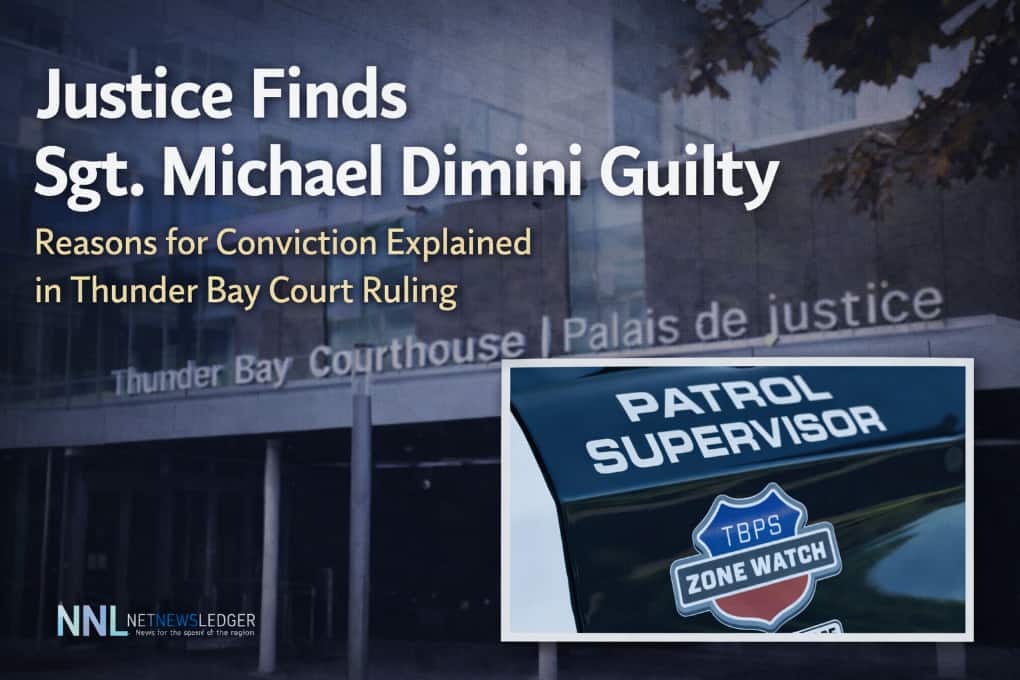
A Thunder Bay case that turned on trust, legal authority, and credibility
Thunder Bay – LEGAL Analysis – In reasons for judgment released February 20, 2026, Justice Michael Block found Thunder Bay Police Service Sergeant Michael Thomas Victor Dimini guilty of breach of trust and obstructing justice by making a false statement.
The case arose from Dimini’s decision—while on duty as a patrol sergeant in Thunder Bay’s north zone—to attend a Keep the Peace/Stand-by call in the south zone on November 24, 2020, tied to a stolen television and other tools.
This analysis is based on the decision by Justice Block. In a 25 page decision, the reasons for the decision are outlined.
At the centre of the ruling were two questions the judge returned to repeatedly:
-
Did Sgt. Dimini have lawful authority to enter Apartment 14 at 230 Frederika Street without a warrant or consent?
-
After the fact, did he attempt to justify that entry by inserting or promoting a false narrative—especially a “fresh pursuit” explanation—in police records?
Justice Block’s answer to both questions was unequivocal, and it is those findings that drove the convictions.
1) The judge found Dimini inserted himself into a call that didn’t require a sergeant—and had a conflict of interest
Justice Block accepted evidence that the call was a fairly common type of assignment: officers attended primarily to keep the peace during a pre-arranged property exchange connected to a stolen TV listed on Facebook Marketplace. The judge heard that sergeants might be called for serious matters—like weapons calls or suicides—but that a stand-by does not usually require a sergeant’s attendance.
What elevated this call, in the court’s view, was Dimini’s personal connection. The complainant (Clody Marson) was the father of Dimini’s common-law partner, a relationship known within communications staff and viewed as a potential conflict. Justice Block treated that perception as relevant context when assessing why Dimini attended and how he behaved once there.
The court also relied on phone record evidence showing communications between Dimini and members of the Marson family that evening, supporting the conclusion that Dimini was not a neutral supervisor stumbling into an unfolding emergency—he had a direct personal interest in the underlying property dispute.
2) The court found the key “trigger” for the later crimes: a warrantless entry with no legal foundation
Justice Block’s breach-of-trust analysis was grounded in the finding that Dimini entered (and drove) a warrantless entry into a private residence without legal authority.
The reasons describe how the television transfer was essentially complete and calm when Dimini arrived. Yet once on scene, multiple witnesses described a rapid escalation: Dimini’s approach changed the dynamic at the doorway, and he forced his way into the unit despite a lack of consent and despite officers initially respecting that they could not lawfully enter without lawful grounds.
A major thread in the judgment is that the lawful bases that might permit a warrantless entry simply weren’t present. Justice Block carefully worked through the main possibilities:
-
Consent: The judge accepted evidence that the occupant (Cassandra Stachiw) did not consent to officers entering her apartment unit, even if she cooperated with the recovery of the television in the hallway.
-
Exigent circumstances / emergency: Justice Block found no credible evidence of an imminent emergency requiring immediate entry. Concerns that emerged later (like a suspected prior shotgun discharge and generalized danger around a wanted man) did not, in the judge’s assessment, translate into lawful urgency at the moment Dimini went in.
-
Reasonable and probable grounds to search for “stolen tools” inside: The court concluded there was not a reasonable basis to believe the stolen tools were in the apartment at that time—and critically, there was no indication tools were about to be destroyed or removed. The judgment notes that tools are not typically contraband and do not inherently create an urgent, evidence-destruction scenario.
Justice Block’s bottom line on the entry: there was no lawful foundation.
That finding mattered not only because an unlawful entry can violate Charter rights—but because Justice Block treated Dimini’s decision to proceed anyway as a serious misuse of police authority.
3) The judge accepted evidence that Dimini knew the entry was unlawful—or at least treated it as “no big deal”
Justice Block emphasized a telling moment: evidence that Dimini characterized the entry as “probably” a Charter breach but “no big deal.” Even allowing for the imperfect recall that can come with years passing, the court treated this as revealing Dimini’s mindset—an awareness that the entry was legally risky or unlawful, paired with a willingness to proceed regardless.
That mindset is central to the breach-of-trust conviction: the judge wasn’t dealing with an officer making a split-second mistake amid chaos; he found conduct reflecting a marked departure from expected legal standards, carried out under the colour of authority.
4) Credibility findings: the court preferred consistent officers’ evidence over after-the-fact justifications
The decision repeatedly turns on credibility.
Justice Block found key Crown witnesses reliable, including Constable Kelly Walsh, whose account was supported by other evidence (including contemporaneous documentation and video context described in the reasons). The judge also dealt carefully with witnesses who had limitations—such as drug use or memory issues—while still accepting core elements where their evidence aligned with independent facts.
By contrast, the court was skeptical of narratives that appeared after the entry—especially those offering a tidy legal rationale that the judge found was missing in real time.
5) GPS and timing evidence undercut the “urgent police duty” narrative
Justice Block relied on GPS evidence placing Dimini near the scene earlier than his physical arrival at the apartment, with a period where he remained nearby. In the court’s view, the timing supported the inference that Dimini could have attended earlier if there had been a true emergency—and that the “urgent necessity” framing didn’t match what actually happened.
That matters because exigent-circumstances arguments often hinge on immediacy. The judge found the facts pointed the other way.
6) How the warrantless entry became a breach of trust
Breach of trust is not simply “bad policing.” It requires a serious misuse of public office.
Justice Block’s reasons link the conviction to several overlapping findings:
-
Dimini used police authority to enter a private dwelling without lawful power, overriding basic constitutional safeguards.
-
He inserted himself into a matter tied to his family relationship, where the appearance (and risk) of conflict was obvious.
-
His presence escalated the encounter and set in motion arrests and a search that followed from that unlawful entry.
Put plainly, the judge found this was not policing for the public good within legal boundaries—it was an abuse of authority in a situation where a reasonable officer would have recognized the need to step back, not take over.
7) The obstruction finding: the court concluded the “fresh pursuit” story was fabricated and inserted into official records
The second conviction—obstructing justice by making a false statement—flowed from the judge’s conclusion that a false justification was later advanced in police documentation.
In the reasons, Justice Block describes concerns raised after the incident when Crown counsel sought the lawful basis for entry. The “fresh pursuit” concept appears as a purported justification—suggesting police were chasing a suspect into the apartment—yet the judge found there was no credible evidence that such a pursuit actually occurred in the way later described.
Crucially, Justice Block points to electronic access/audit-style evidence about police record handling (including early-morning access to reports and subsequent edits) as supporting an inference that the false narrative was not an innocent mistake—it was a deliberate attempt to backfill legality into an incident that had unfolded without lawful grounds.
The obstruction wasn’t framed as a technical paperwork issue. Justice Block treated it as a serious act because police records shape:
-
Charter litigation and disclosure,
-
bail decisions and prosecutions,
-
and public confidence in accountability.
If an unlawful entry can be “fixed” later by inserting a legal-sounding narrative, the justice system itself is compromised—that is the core harm the obstruction offence addresses.
8) Why this ruling lands heavily in Thunder Bay
This case matters locally for reasons beyond one officer’s conduct.
Thunder Bay residents regularly encounter policing through traffic stops, mental health calls, domestic disputes, and community safety initiatives.
Those interactions depend on a shared understanding that officers operate within lawful authority, and that official records reflect what truly happened.
Justice Block’s ruling is a reminder of two community-level realities:
-
Charter-compliant policing is not a technicality—it is the line between public safety and state overreach.
-
Record integrity is a public trust issue—because when records become narrative “repair tools,” the court process can’t function honestly.
In Northwestern Ontario—where trust in institutions can be strained by distance, resource pressures, and high-profile controversies—decisions like this one resonate beyond the courthouse.
What to watch next
Justice Block’s reasons establish why the convictions were entered. The next steps that often follow in cases like this can include sentencing proceedings and professional/administrative consequences—but those outcomes are separate from the guilt findings addressed in this ruling.
The key takeaway from the judgment is straightforward: the convictions were driven by the court’s finding that Dimini acted without lawful authority, in a conflict-tainted context, and then supported or inserted a false story to justify the entry after the fact.