Independent review will examine safeguards across 45 services, including OPP, and the boards that oversee them
Database access, recruitment vetting, evidence handling, supervision and officer fitness-for-duty among key focus areas
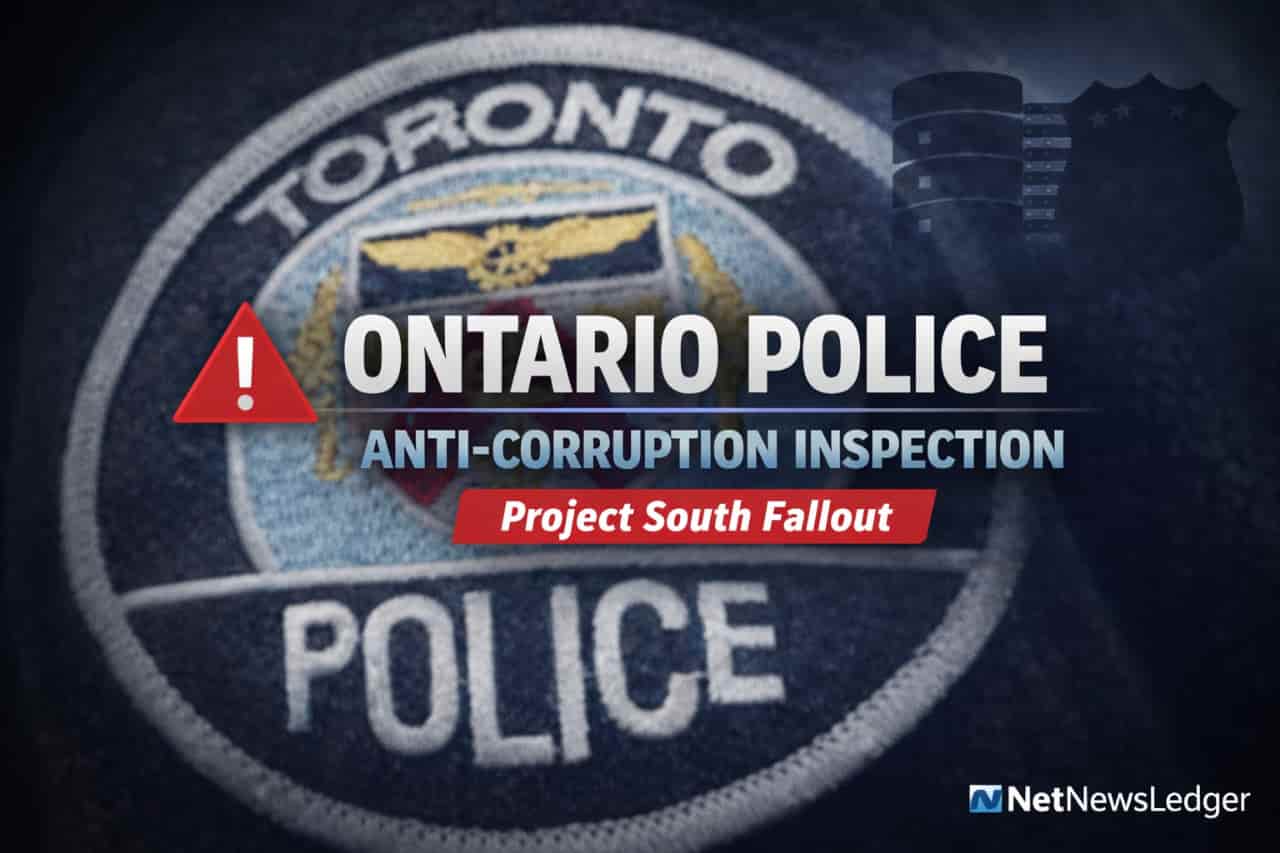
QUEEN’S PARK — Ontario’s Inspector General of Policing is ordering a province-wide inspection of police integrity and anti-corruption safeguards in the wake of Project South, a sweeping organized-crime probe that has led to charges against seven Toronto Police Service officers and one retired officer, along with 19 other suspects.
Inspector General Ryan Teschner said Monday an external, independent inspector will be appointed to assess how Ontario’s police services—and the civilian boards that oversee municipal forces—can better prevent, detect and respond to corruption, and “fortify” their organizations against it. The review is expected to span all 45 police services in the province, including the Ontario Provincial Police.
The announcement comes as the Project South allegations continue to send shockwaves through policing and public confidence—particularly around the misuse of confidential police information and potential links between officers and organized crime.
What the inspection will examine
According to the Inspector General’s outline, the inspection will focus on five core areas—though Teschner indicated the scope could widen as the work unfolds:
-
Supervision and span of control (how officers are managed day-to-day)
-
Screening and vetting at recruitment and throughout careers
-
Access controls and auditing around police databases and information systems
-
Evidence and property management practices
-
Substance abuse and fitness for duty, including supports available to officers
Teschner has emphasized the work must be rigorous and independent, and structured so it does not interfere with ongoing criminal investigations or prosecutions connected to Project South.
At the conclusion of the review, the external inspector will deliver a report to the Inspector General. That report is expected to be made public, and Teschner may issue legally binding directions if the inspection identifies non-compliance with Ontario’s policing legislation or failures to provide “adequate and effective” policing.
Project South: the allegations driving the provincewide response
Project South began in June 2025, after investigators uncovered and disrupted an alleged conspiracy to commit murderat a York Region home—an incident police say helped expose deeper corruption concerns.
York Regional Police allege an officer unlawfully accessed a police database to obtain confidential information, and that further investigation uncovered numerous alleged unlawful database queries involving additional officers. In multiple instances, investigators say addresses tied to those queries later became sites of criminal activity, including extortion, robberies and shootings.
York police further allege confidential information was shared with individuals connected to organized criminal networks, and that the investigation later uncovered additional alleged misconduct, including:
-
Bribery-related allegations tied to protecting the operation of illegal cannabis dispensaries
-
Drug trafficking allegations, including cocaine-related charges against some officers
-
Allegations involving theft of personal identity documents (such as licences, health cards and passports)
-
Broader arrests tied to alleged trafficking of substances including cocaine, methamphetamine, fentanyl, heroin and oxycodone
Police stress the allegations have not been proven in court.
In the days following the arrests, three Peel Regional Police officers were suspended pending further investigation by York Regional Police. Peel police have said those officers have not been charged.
Why this is a “stress test” for Ontario’s new oversight regime
The anti-corruption inspection will be one of the highest-profile tests yet of Ontario’s reworked police oversight system under the Community Safety and Policing Act (CSPA), which came into force April 1, 2024. The CSPA replaced the Police Services Act and created (or reshaped) agencies including the Inspector General of Policing and the Law Enforcement Complaints Agency (LECA).
In Toronto, Chief Myron Demkiw and Police Service Board Chair Shelley Carroll have publicly welcomed the provincewide inspection. Demkiw has also said he is seeking suspension without pay for six of the seven charged officers, while noting legislation prevents him from doing the same for the seventh accused officer at this time.
Toronto Police have also outlined internal moves—such as strengthening Professional Standards and adding supervisory capacity in the division at the centre of the allegations—while supporting the external inspection.
Separately, Toronto Police say they have been advised that LECA will take responsibility for allegations under the CSPA tied to the matter—signalling that disciplinary and misconduct processes will not simply be handled internally, even as criminal proceedings move forward elsewhere.
What this could mean for Thunder Bay and Northwestern Ontario
For readers in Thunder Bay and the Northwest, the key point is this: the inspection is being framed as sector-wide, not as a review triggered by allegations in any one region outside the GTA. But because it covers all police services and boards, it will inevitably reach Northern Ontario institutions as well—municipal services, local police governance bodies, and the OPP.
That matters locally for three reasons:
1) Governance will be under the microscope—not just frontline policing
Boards that oversee municipal police services are expected to be assessed alongside forces. The inspection’s focus on “fortifying organizations” suggests attention will land on how boards demand evidence of integrity controls, not simply whether a service has a policy binder on a shelf.
2) Data systems and database access are central—and relevant everywhere
Project South’s most alarming claims centre on misuse of confidential systems. The provincewide inspection’s emphasis on database access controls raises questions every community will recognize: Who can access what? How is access audited? Are alerts triggered for suspicious searches? Those aren’t big-city-only issues; they’re governance fundamentals for any service handling sensitive information.
3) “Integrity” includes officer wellness and fitness-for-duty
By explicitly including substance abuse and fitness-for-duty, the inspection may also test whether police organizations have credible supports and clear thresholds for action—especially in smaller or remote settings where staffing pressures and mental-health strain can be acute.
What to watch next
-
Who is appointed as external inspector, and what expertise they bring
-
Whether the inspection issues interim recommendations before the final report
-
What “best practices” emerge for audit trails, evidence control, and vetting standards across Ontario
-
Whether the Inspector General issues binding directions, and how quickly services implement them
For Thunder Bay and Northwestern Ontario, the most immediate question may be practical: how quickly local services and boards can demonstrate their anti-corruption controls in a way that’s measurable, auditable, and understandable to the public—because this inspection is explicitly about restoring trust province-wide.