THUNDER BAY / CALGARY / MONTREAL — February 9, 2026 — A Thunder Bay-based Indigenous-owned consultancy is pushing a major rethink of how First Nations participate in Canada’s mining and energy economy, arguing the long-dominant Impact Benefit Agreement (IBA) model is no longer aligned with the true value — or risk — of large resource projects.
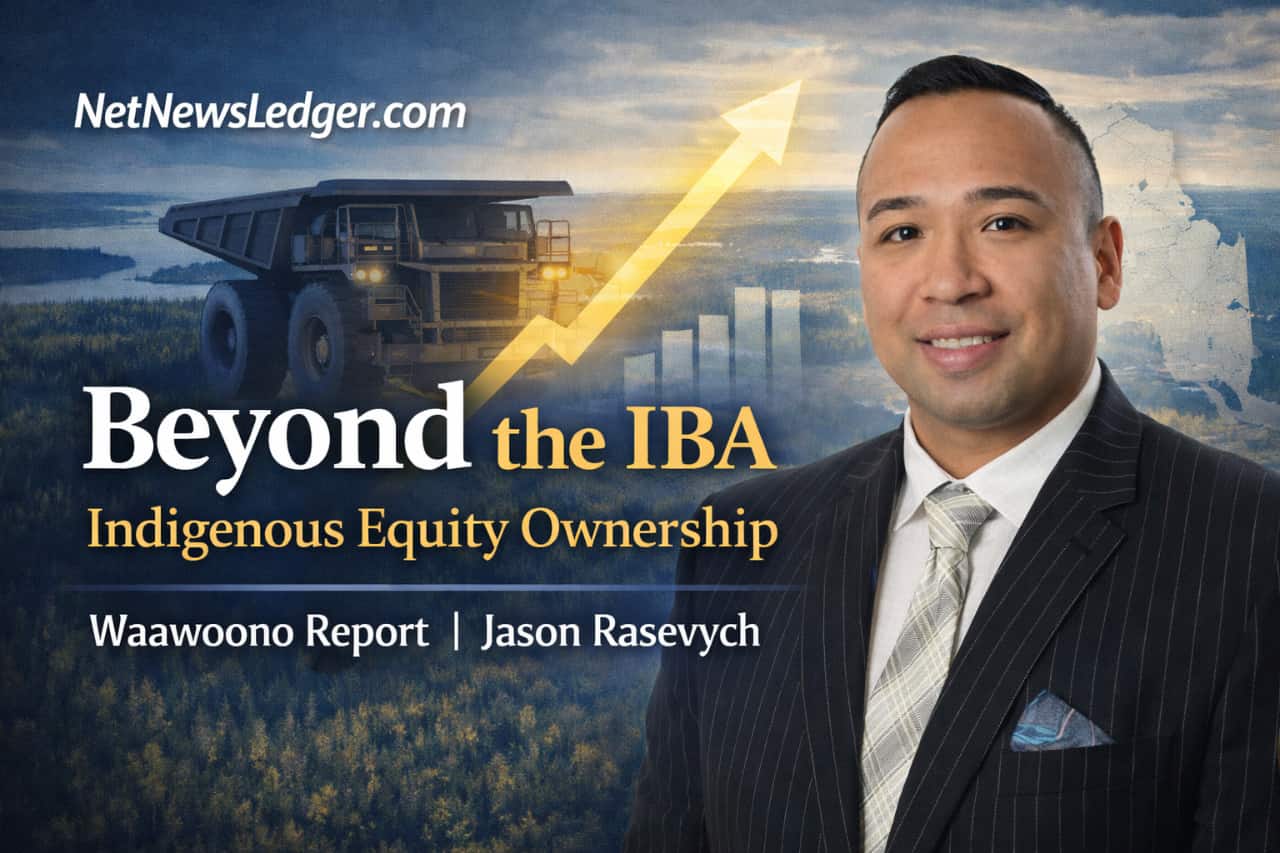
Waawoono Consultancy has released a strategic report titled Beyond the IBA: The Evolution of Indigenous Equity Ownership & Sovereign Wealth Generation, authored by Jason Rasevych of Ginoogaming First Nation. The report contends that “transactional” approaches built around fixed payments and limited benefits are increasingly out of step with a new era where Nations are seeking direct equity ownership, governance influence, and long-term wealth generation.
From “stakeholders” to owners
In the report, Waawoono argues that legacy agreements can become “structurally disconnected” from project performance — particularly during commodity “super-cycles,” when project revenues surge but fixed payments to communities remain static and lose real value over time.
The report uses examples including the Musselwhite Mine to illustrate how fixed-payment structures can erode in purchasing power while commodity prices climb — leaving communities with returns that do not reflect the scale of extraction occurring on or near their traditional territories.
Waawoono also positions the rise of new Indigenous financing tools — including the Canada Indigenous Loan Guarantee Corporation (CILGC) referenced in the report — as a catalyst accelerating the move from set payments to ownership models. Rasevych’s report argues this shift is pushing Nations from being consulted “stakeholders” to becoming partners with boardroom-level influence.
“Certainty premium” and investor de-risking
One of the report’s central claims is that Indigenous equity isn’t only about fairness — it changes the project’s risk profile in ways capital markets understand.
Waawoono outlines what it calls a “certainty premium”: when a First Nation holds a large ownership stake — the report uses a 50% example — the likelihood of prolonged conflict, litigation, and permitting instability can drop sharply, improving investor confidence and lowering borrowing costs. The report frames equity partnerships as a form of de-risking that benefits both communities and proponents.
A negotiating playbook: veto rights and infrastructure ownership
Beyond the big picture, the Waawoono report reads as a tactical guide for Nations preparing for negotiations.
Among its featured strategies:
-
The “Golden Share” concept: Waawoono suggests negotiating a specific class of shares that carries veto rightsover critical environmental decisions — designed to preserve land-based sovereignty even where a Nation holds a minority equity position.
-
Ring of Fire “Utility Model”: The report contrasts traditional mining deal structures with a model where Nations own enabling infrastructure — especially transmission — which functions like a “toll road” to development. Waawoono argues this can deliver steadier, bond-like revenue streams that are less exposed to volatile mineral prices.
-
Leveraging the “spread”: The report claims that with federal-style loan guarantees, Nations may be able to borrow at lower, near-sovereign rates and invest in assets generating higher returns — using the difference to fund community priorities without drawing from existing program budgets.
-
Treating “social impact” as balance-sheet risk: Waawoono urges communities to frame social pressures — such as housing, roads, policing, and health system strain linked to major projects — as quantifiable liabilities that should be addressed through ownership and revenue tools, not ad hoc “community investments.”
While the report’s language is blunt at times in dismissing outdated approaches, its core argument is that a project’s footprint and downstream impacts require more than one-time payments — and that equity can provide both resources and leverage.
Jason Rasevych takes the message national
Waawoono says Rasevych will bring the report’s core ideas to two major forums this week, speaking directly to leadership, industry, and policy audiences.
Calgary: AFN National Natural Resources Forum
Rasevych is scheduled to appear at the Assembly of First Nations National Natural Resources Forum on Tuesday, February 10, 2026, during a plenary panel titled Investing in Prosperity: Activating First Nations Equity for Nation-Building (11:30 a.m. to 12:00 p.m., Macleod Hall B-C-D, Calgary TELUS Convention Centre). Waawoono says the discussion will focus on closing the “capital gap” and how Indigenous equity is reshaping investment decisions in major projects.
Montreal: AFOA Canada National Conference
On Wednesday, February 11, 2026, Waawoono’s team — including Maite Fink, CPA, EMBA, and Landen Jourdain— is set to lead a session at the AFOA Canada 24th National Conference titled Wealth Generation — Beyond IBAs: Equity Ownership for Community Wealth (2:45 p.m. to 4:15 p.m., Room 522, Level 5, Palais des congrès de Montréal). Waawoono describes this as a deeper workshop on structuring equity deals and building the internal capacity required to manage them.
“Our report is a playbook for Nations to stop being treated as creditors to be paid off, and start operating as partners to be invested in,” Rasevych said in the release, adding that new tools and frameworks are emerging and the next step is execution.
What this could mean for Northwestern Ontario
For communities across Northern Ontario — including those affected by mining expansion, transmission corridors, and long-term resource development — the equity discussion isn’t theoretical. It ties directly to whether major projects deliver:
-
stable own-source revenue,
-
improved housing and infrastructure,
-
long-term employment and procurement pathways,
-
and governance power that matches the scale of development.
Waawoono’s report positions equity ownership and Indigenous-led investment vehicles as a route toward intergenerational wealth — not only mitigating harms, but building lasting economic sovereignty.
About Waawoono Consultancy and ABPA
Waawoono Consultancy is a Thunder Bay-based Indigenous-owned firm specializing in regulatory processes, complex negotiations, and economic strategy. The firm describes its approach as “two-eyed seeing,” bridging Indigenous sovereignty and corporate finance.
Rasevych is also associated with the Anishnawbe Business Professional Association (ABPA), a non-profit, member-based organization supporting First Nation business communities across multiple treaty areas in Northern Ontario, including Treaty #3, Treaty #5, Treaty #9, and the Robinson Superior and Robinson Huron treaty regions.
.Jason Rasevych,Waawoono Consultancy,Ginoogaming First Nation,Indigenous equity ownership,Impact Benefit Agreements,IBA,mining,resource development,Indigenous sovereignty,wealth generation,sovereign wealth,Ring of Fire,Indigenous infrastructure,AFN,AFOA Canada,Indigenous business,Northwestern Ontario,Thunder Bay