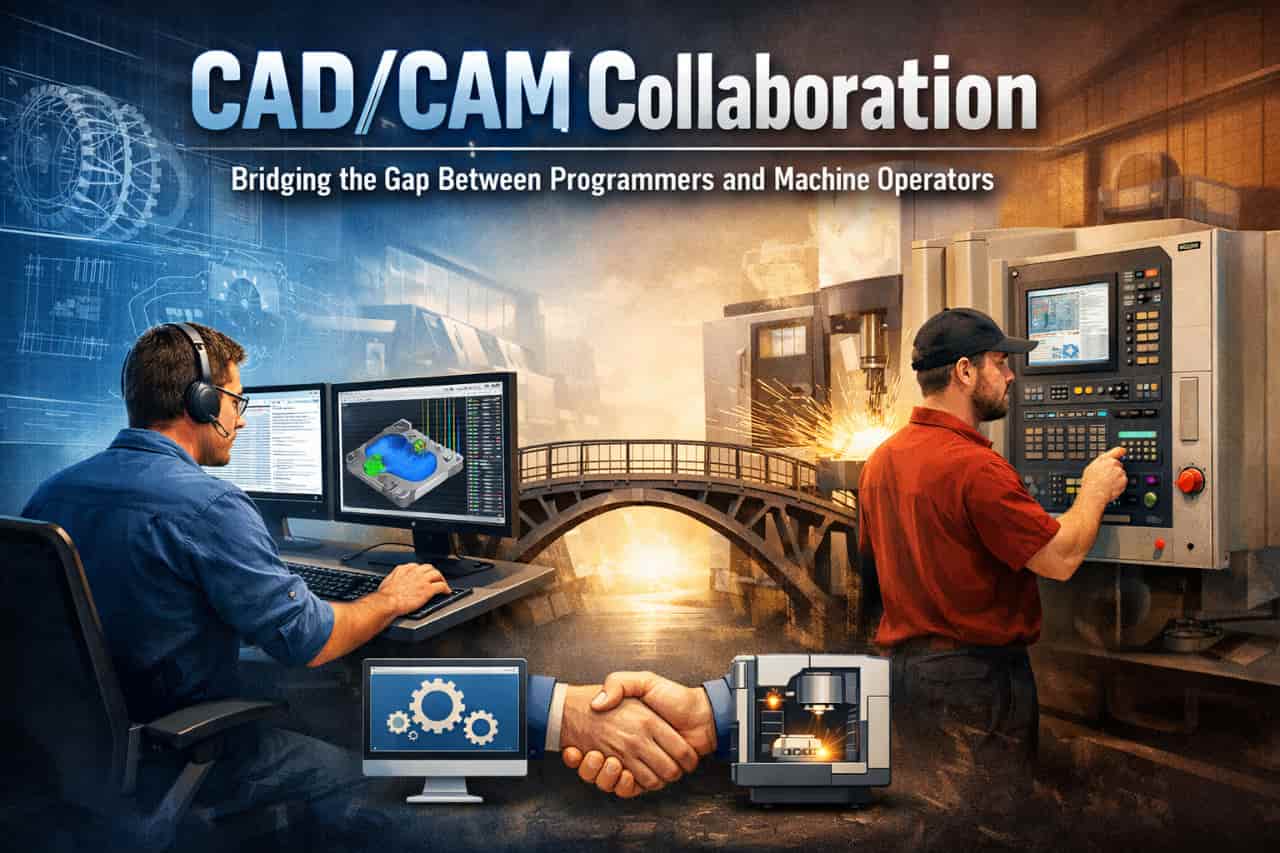
When a €2.4 million CNC machine sits idle for three hours because an operator can’t reach the CAM programmer to clarify a toolpath issue, something’s fundamentally broken. This scenario plays out more times across manufacturing floors in the US and Europe.
The gap between CAD/CAM programmers working in air-conditioned offices and machine operators on the shop floor isn’t just physical—it’s a communication chasm that bleeds money, time, and production quality every single day.
The Real Cost of Poor Communication
A mid-sized aerospace parts manufacturer ran the numbers. Turned out that communication delays between their programming team and CNC operators were responsible for 23% of their unplanned downtime. Twenty-three percent! That translated to roughly $380,000 in lost productivity.
The problems usually start small. An operator notices something odd in a toolpath simulation but can’t get immediate clarification. Maybe the programmer is in a meeting, or they’re working on another urgent project. So the operator makes their best guess… and sometimes that guess costs the company a $15,000 workpiece.
Here’s what typically happens in traditional setups:
- Programmer creates complex 5-axis toolpaths in their CAM system
- Files get emailed (or worse, saved to a shared network drive somewhere)
- Operator downloads the NC code hours later
- Questions arise during setup or first article inspection
- Back-and-forth emails begin, or the operator walks across the facility
- Production waits
One team exchanged 47 emails over two days trying to resolve a simple fixture offset question. Forty-seven!
Why Email and Messaging Apps Make Everything Worse
You’d think modern communication tools would solve this, right? Well… not really.
The problem with email is context loss. When you’re discussing technical details—specific tool numbers, work coordinate systems, material hardness values—information gets scattered across threads. Someone forwards a message without the full history. Critical details live in different places.
And messaging apps? Sure, they’re faster than email. But try finding that conversation from three weeks ago where someone explained the exact feed rate adjustment for that tricky titanium part. Good luck scrolling back through hundreds of messages about production schedules, lunch orders, and machine maintenance reminders.
Plus, these tools create artificial separation. The CAM programmer is working in their software environment, completely disconnected from where the actual machining happens. The operator is at the machine, disconnected from the programming context.
It’s like two people trying to build something together while standing in different rooms, shouting instructions through the walls.
Cloud Platforms Are Changing the Game
Modern manufacturing needs something different. Not just faster communication—smarter communication that’s built into the workflow itself.
Cloud-based platforms designed specifically for CAD/CAM collaboration are starting to address this. Instead of programming happening in isolation and then files getting tossed over the wall to production, everything exists in a shared space from the start.
Think about it this way: when a programmer creates toolpaths, that project—complete with 3D models, setup sheets, and tool lists—lives in the cloud where operators can access it immediately. Not “eventually” or “after the email arrives” but right now.
Some manufacturing teams have started using platforms like https://encycam.com/ that integrate cloud storage, real-time chat, and project management directly into the CAM environment. The difference is pretty dramatic when you see it in action.
For instance, one automotive supplier cut their programming-to-production handoff time from an average of 4 hours down to about 20 minutes. How? The operator could see the programmer’s work as it developed, ask questions in context, and start machine setup before the program was even finalized.
Built-in Communication Tools That Actually Work
Here’s where things get interesting. When communication tools are embedded directly into the CAD/CAM workflow rather than bolted on afterward, collaboration becomes natural instead of forced.
Imagine this scenario: An operator is reviewing a new program for a complex impeller. They notice the approach angle on one of the roughing passes looks aggressive. Instead of stopping what they’re doing to send an email, they add a comment with their question, and tag the programmer. The programmer gets a notification, sees exactly which operation the operator is asking about, and responds immediately.
The whole exchange takes maybe 90 seconds. No context switching. No searching through email threads. No ambiguity about what’s being discussed.
Better yet, that conversation becomes part of the project documentation. Six months later when someone needs to run that part again, the context is right there. All the decisions, clarifications, and tweaks are preserved.
This kind of integrated communication also enables quick technical support when things go sideways. One job shop had their CAM vendor’s support team directly accessible through their programming platform. When they ran into a kinematic issue programming a Swiss-type lathe, they could share their project instantly with support engineers who could see exactly what they were working with.
Response time? About 15 minutes versus the typical 2-3 day email back-and-forth for complex technical issues.
Measuring the Real Impact
So let’s talk about the results.
A contract manufacturer tracked their metrics before and after implementing cloud-based collaboration tools. They documented:
Setup time reduction: 34% decrease in average machine setup time. When operators had immediate access to programming notes, 3D models, and could ask questions in real-time, they spent less time figuring things out.
Scrap rate improvement: Mistakes from miscommunication dropped their scrap rate from 2.3% to 0.8%. That might not sound huge, but on their annual production volume, it saved them about $180,000.
Programming efficiency: Their CAM programmers are spending 40% less time on communication and clarification. That freed them up to handle more projects without adding headcount.
First-article success rate: They went from 73% to 91% first-time success on new jobs. Fewer do-overs, less rework, happier customers.
But here’s what really sold me on their story—the soft benefits. Their operators are feeling more confident and engaged. Instead of being order-takers who just ran whatever code showed up, they became active collaborators in the manufacturing process.
Making the Transition
Look, I won’t pretend switching to cloud-based collaboration is trivial. Change is hard, especially in manufacturing where “if it ain’t broke, don’t fix it” is basically a religion.
But the status quo—programmers and operators working in separate silos, connected only by file transfers and periodic meetings—isn’t actually “not broken.” It’s costing you money and headaches every single day.
Start small. Pick one project or one production cell. Get your CAM programmers and operators using the same collaborative platform for that specific work. Measure what happens. Track your setup times, communication delays, and error rates.
The results usually speak for themselves pretty quickly.
Modern manufacturing is complicated enough without making collaboration harder than it needs to be. When programmers and operators can work together seamlessly—sharing context, asking questions, solving problems in real-time—everything else gets easier.
And your bottom line definitely notices.