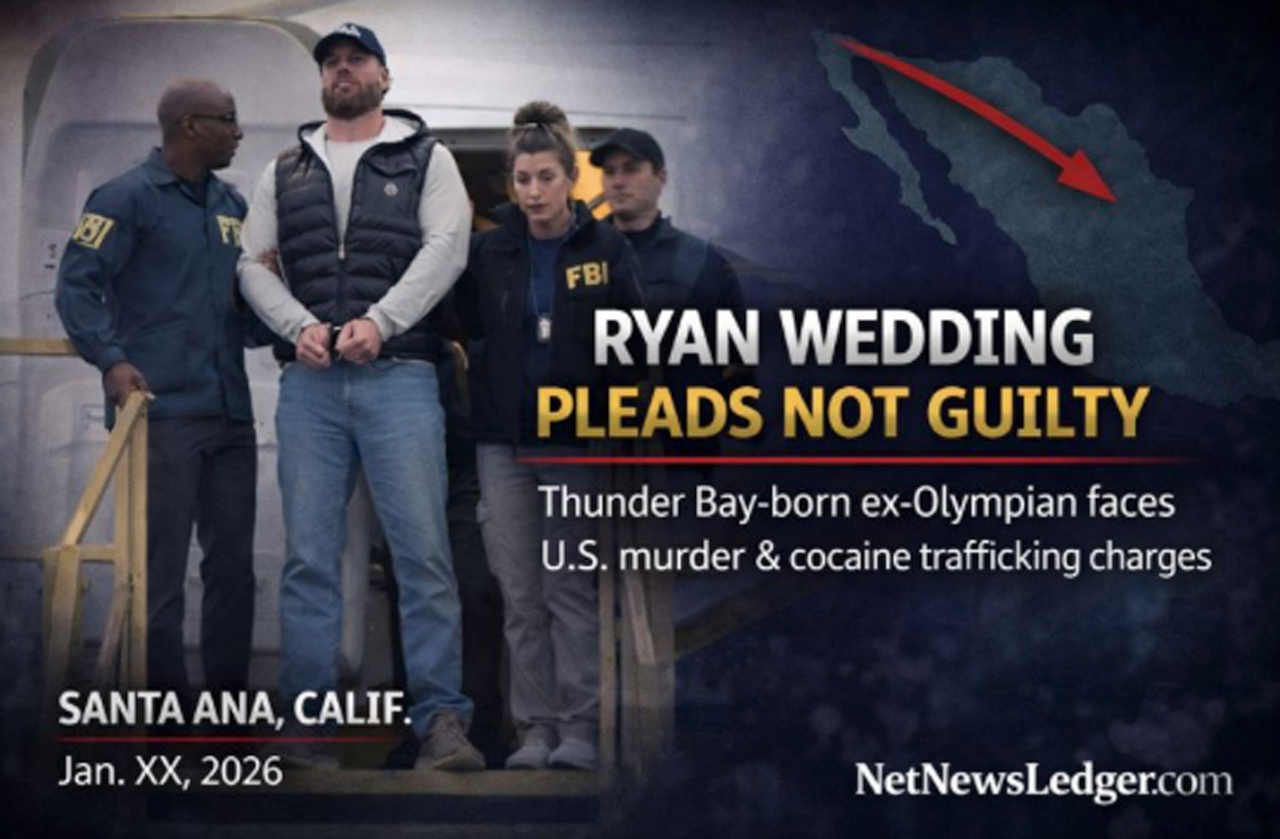
First Court Appearance After Mexico Arrest
Ryan James Wedding — a Canadian former Olympic snowboarder born in Thunder Bay — has pleaded not guilty in a U.S. federal courtroom in Santa Ana, California, after authorities said he was taken into custody in Mexico City and transported to Southern California.
Wedding, 44, is named in two separate U.S. indictments comprising 17 felony charges, according to reporting from Reuters and the Los Angeles Times. A U.S. magistrate judge ordered him held without bond, with a return-to-court date set for Feb. 11 and a tentative trial date of March 24.
Defence Pushback on “Surrender” Narrative
Mexican officials initially suggested Wedding surrendered at the U.S. Embassy in Mexico City, but his lawyer, Anthony Colombo, disputed that account, telling reporters Wedding “was arrested” and “did not surrender.”
Colombo — a San Diego defence lawyer who has represented high-profile cartel-linked defendants — confirmed he had recently met his client and cautioned that indictments are allegations, not proof.
From Thunder Bay Roots to International Manhunt
Wedding’s Canadian sports biography lists Thunder Bay, Ontario as his birthplace and confirms he competed for Canada at the 2002 Salt Lake City Olympics.
His name also isn’t new to U.S. courts: Wedding was convicted in a San Diego cocaine conspiracy case and later sentenced to four years in a U.S. federal prison in 2010, according to archived reporting.
What Prosecutors Allege
U.S. authorities allege Wedding led a transnational cocaine operation tied to Mexico’s Sinaloa Cartel, moving large quantities of cocaine from Colombia through Mexico, into the United States and onward to Canada, and that the organization used violence — including killings in Ontario and Colombia — to protect shipments and punish perceived thefts or debts.
The Charges Wedding Faces: Two Indictments, 17 Felonies
Indictment One: 2024 Superseding Case Focused on Bulk Cocaine Shipments and Murders
In an October 2024 superseding indictment unsealed in the Central District of California, prosecutors alleged Wedding and others coordinated hundreds of kilograms of cocaine shipments from Southern California into Canada using long-haul trucking couriers, and that the group ordered killings tied to stolen shipments and drug debts.
According to the U.S. Department of Justice, Wedding is charged in that case with eight felonies, including:
-
Two counts: conspiracy to distribute controlled substances
-
One count: conspiracy to export cocaine
-
One count: leading a continuing criminal enterprise (the “CCE” or “kingpin” statute)
-
Three counts: murder in connection with a continuing criminal enterprise and drug crime
-
One count: attempted murder in connection with a continuing criminal enterprise and drug crime
Indictment Two: 2025 Case Adds Witness-Related Murder, Retaliation, and Money Laundering Allegations
A separate federal indictment (filed as a 2025 case) expands the allegations, including claims tied to the killing of “Victim A” and a broader span of alleged trafficking activity dating back years.
The indictment lists these counts (Wedding is named among the defendants on each):
-
Count 1 — 21 U.S.C. § 846: conspiracy to distribute and possess with intent to distribute cocaine
-
Count 2 — 21 U.S.C. § 963: conspiracy to export cocaine
-
Count 3 — 21 U.S.C. §§ 846, 848(e)(1)(A): conspiracy to commit murder in connection with a continuing criminal enterprise and drug crime
-
Count 4 — 21 U.S.C. § 848(e)(1)(A) (+ aiding/abetting): murder in connection with a continuing criminal enterprise and drug crime
-
Count 5 — 18 U.S.C. § 1512(k): conspiracy to tamper with a witness/victim/informant
-
Count 6 — 18 U.S.C. §§ 1512(a)(1)(A),(C),(3)(A), (k): witness tampering by completed murder (and related conspiracy language)
-
Count 7 — 18 U.S.C. § 1513(f): conspiracy to retaliate against a witness/victim/informant
-
Count 8 — 18 U.S.C. §§ 1513(a)(1)(A),(B),(2)(A): retaliation against a witness/victim/informant by completed murder
-
Count 9 — 18 U.S.C. § 1956(h): conspiracy to launder monetary instruments
The indictment also seeks criminal forfeiture of assets allegedly tied to the offenses.
What Conviction Could Mean: Life Sentences and Asset Forfeiture
Wedding “could face a sentence of life in prison” if convicted on the most serious counts.
Several of the statutes cited in the indictments carry extremely severe sentencing ranges:
-
The CCE statute (21 U.S.C. § 848) provides for 20 years to life imprisonment for a first conviction (with higher minimums in some circumstances).
-
Drug-related murder tied to a continuing criminal enterprise (21 U.S.C. § 848(e)(1)(A)) provides a penalty range from at least 20 years up to life, and in some circumstances the statute allows the death penalty.
-
Witness tampering involving killing/attempted killing under 18 U.S.C. § 1512 can carry penalties up to life imprisonment (and in certain murder scenarios, death is authorized under federal law).
-
Money laundering (18 U.S.C. § 1956) carries up to 20 years per count, plus substantial fines and forfeiture exposure.
What any individual defendant ultimately faces depends on what is proven at trial (or admitted in a plea), how counts are structured, and U.S. federal sentencing rules.
Even though the prosecution is unfolding in U.S. court, the allegations repeatedly point north: prosecutors say the trafficking pipeline was designed to push cocaine into Canadian markets, and the violence alleged includes killings in Ontario.
For Thunder Bay readers, Wedding’s biography — from local roots to Olympic competition — adds a stark dimension to a case that U.S. officials are positioning as a major cross-border organized crime prosecution.