When politicians attack the referee and platforms reward outrage, broken promises multiply—and communities lose a shared set of facts
The bigger question: why truth and promises collapse in politics
THUNDER BAY – EDITORIAL – Voters often assume broken promises are just personal failings—politicians are “liars.” Sometimes that’s true. But many failures are structural:
-
Campaigns reward certainty (clear promises) more than honest complexity (trade-offs and limits).
-
Governing is constrained by budgets, courts, legislatures, and crises.
-
Party discipline and donor ecosystems can steer priorities away from local needs.
-
Media cycles and social platforms punish “slow truth” and reward instant, emotional claims.
In short: politics already had incentives to stretch reality. The last decade added something worse—a collapsing agreement on what counts as reality in the first place.
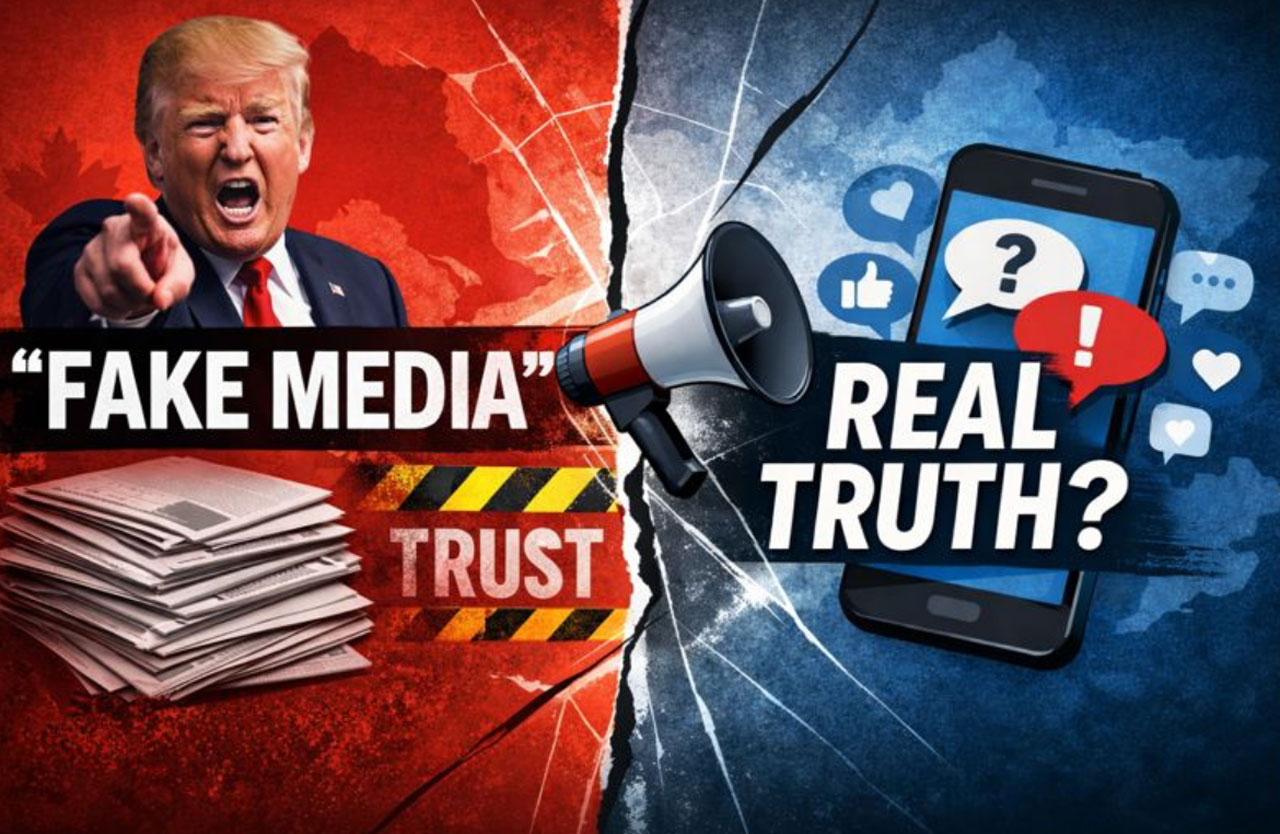
Trump’s accelerant: “Fake News” as a strategy, not a critique
U.S. President Donald Trump’s rise didn’t create mistrust in media, but it weaponized it. By repeatedly framing major outlets as dishonest—sometimes calling them “the enemy of the people”—Trump shifted the argument from evidence to loyalty: if a story hurts your side, dismiss the source.
This is crucial: truth becomes rarer when leaders can evade accountability by attacking the referee. A critical report isn’t something to answer; it’s something to delegitimize.
This has also been seen in partisan media outlets, and in social media bloggers and influencers who work toward their own agendas.
Volume matters: when false or misleading claims become “normal”
Trump-era politics also demonstrated how sheer repetition can reshape what people accept as normal.
The Washington Post Fact Checker documented 30,573 false or misleading claims by Trump during his first term in office.
Whether one agrees with that newspaper’s editorial posture or not, the database illustrates a wider point: when a leader floods the zone, audiences burn out. They stop evaluating each claim and instead choose a team.
This approach of making the medium the target, and blaming the media, or claiming as some social media influencers do – claiming they are the only ones telling the truth, This is not unlike the propaganda that was practiced in the not to distant past in Nazi Germany.
Social media turns distrust into a business model
Social platforms didn’t invent propaganda—but they optimized distribution. Algorithms tend to reward content that triggers strong reactions: anger, fear, outrage, smug certainty.
A landmark study of Twitter rumor cascades found that false news traveled farther, faster, deeper, and more broadly than true news, largely because of human sharing behavior, not just bots.
That’s the perfect environment for “fake news” politics:
-
A politician makes a claim.
-
Critical reporting follows.
-
The politician labels it “fake,” and supporters share that label.
-
The audience gets two competing stories and chooses the one that fits identity.
The new gatekeepers: influencers and “bloggers with an agenda”
Here’s the paradigm shift: many people no longer get news from institutions; they get it from personalities.
-
Pew Research found 21% of U.S. adults regularly get news from social media “news influencers.”
-
Reuters Institute reporting describes major shifts toward social/video networks and online personalities, especially among younger audiences.
This isn’t automatically bad. Some independent creators do serious work. The problem is that the “influencer” ecosystem often replaces editorial standards with branding:
“Only I tell the real truth”
Many agenda-driven accounts sell certainty as a product. They position mainstream coverage as a coordinated lie and their own feed as the only “real truth.”
Their goal appears to be framing the “truth” as something that only they are in the position to tell you, and that you should never listen to anyone else.
That framing is powerful because it:
-
flatters the audience (“you’re smarter than the sheep”),
-
immunizes the creator from criticism (“critics are corrupt”), and
-
reduces complex issues to shareable slogans.
When creators won’t even be transparent about themselves
Another risk: low accountability. Some personalities are anonymous, vague about credentials, or unclear about funding and sponsorships—yet demand total trust.
UNESCO reported survey results suggesting 62% of digital content creators don’t do rigorous, systematic fact-checking before sharing. Most have no training in how do do “real” journalism, and are simply expressing agenda spew.
That gap—high influence, uneven verification—creates space for confident misinformation dressed up as “authentic truth.”
Why “right-wing media dynamics” have been especially effective here
Misinformation exists across ideologies. But Trump-era “fake news” rhetoric has been especially effective in parts of the right-wing ecosystem because it fits long-standing narratives about liberal bias, elites, and institutions.
Reuters Institute findings and related reporting highlight that prominent online personalities can attract audiences who already distrust mainstream media and prefer identity-based commentary over institutional reporting.
The practical effect is a media environment where:
-
facts are treated as partisan,
-
corrections are treated as attacks,
-
and “truth” becomes whatever your side repeats most.
The measurable outcome: trust collapses and reality fractures
This is not a vibe—it shows up in long-running data.
Gallup reports a major partisan split in U.S. trust in mass media: in 2024, 54% of Democrats said they had a “great deal” or “fair amount” of trust, versus 12% of Republicans.
Research also suggests “fake news” accusations can reduce trust in targeted outlets and perceived accuracy of their reporting—even when trust in the accusing politician doesn’t rise much.
This is how communities become ungovernable by consensus: every inconvenient fact can be dismissed as propaganda, and every rumour can be sold as “real truth.”
Why Thunder Bay should care: U.S. information wars don’t stop at the border
Thunder Bay readers share the same feeds as everyone else. U.S.-style distrust spills into Canadian debates about:
-
public health,
-
policing and public safety,
-
resource development,
-
affordability and housing,
-
and Indigenous issues where accuracy and care are essential.
Statistics Canada reports 59% of Canadians were very or extremely concerned about misinformation online in 2023, and 43% felt it was getting harder to tell truth from fiction online compared with three years earlier.
Once people feel they can’t know what’s real, they’re more vulnerable to simple narratives—and more likely to disengage from civic problem-solving altogether.
When looking at social media influencers and bloggers, ask yourself, do they have an agenda? Are they providing balance in their reporting? Do they fact check their reports?
What honest politics and credible journalism looks like now
If the “fake news” era changed the rules, the response can’t be “just trust us.” It has to be verifiable trust.
For politicians (and anyone making promises)
-
Be specific: timelines, costs, constraints.
-
Separate goals from guarantees.
-
Publish progress updates—especially when plans fail.
For local newsrooms (NetNewsLedger-style positioning)
-
Show your work: link to documents, datasets, meeting minutes.
-
Label certainty: what’s confirmed vs. what’s alleged vs. what’s unknown.
-
Correct loudly: visible corrections build credibility faster than “perfect tone.”
-
Explain trade-offs locally: “What does this mean for Thunder Bay jobs, costs, services?”
For readers
Canada’s own guidance on disinformation emphasizes pausing when content is emotionally triggering and checking sources before sharing. In practice: look for documentation, independent corroboration, and transparent sourcing—especially from accounts selling “only we tell the truth.”
Bottom line
Honesty in politics was never easy. But Trump’s “fake news” weaponization, combined with social media’s incentives and a booming influencer economy, has pushed public life further into competing realities—where promises can be made without consequence and “truth” becomes a brand.
For Thunder Bay and Northwestern Ontario, the stakes are practical: communities need shared facts to make shared decisions. Without that, everything—budgets, safety, reconciliation, development—turns into permanent conflict.
Thanks for reading!
James Murray