Eight deaths, a small population, and a big per-capita spike
Thunder Bay – NEWS – Statistics Canada’s latest homicide release shows police reported 788 homicides across Canada in 2024, eight fewer than in 2023, and the national homicide rate fell 4% to 1.91 per 100,000 people.
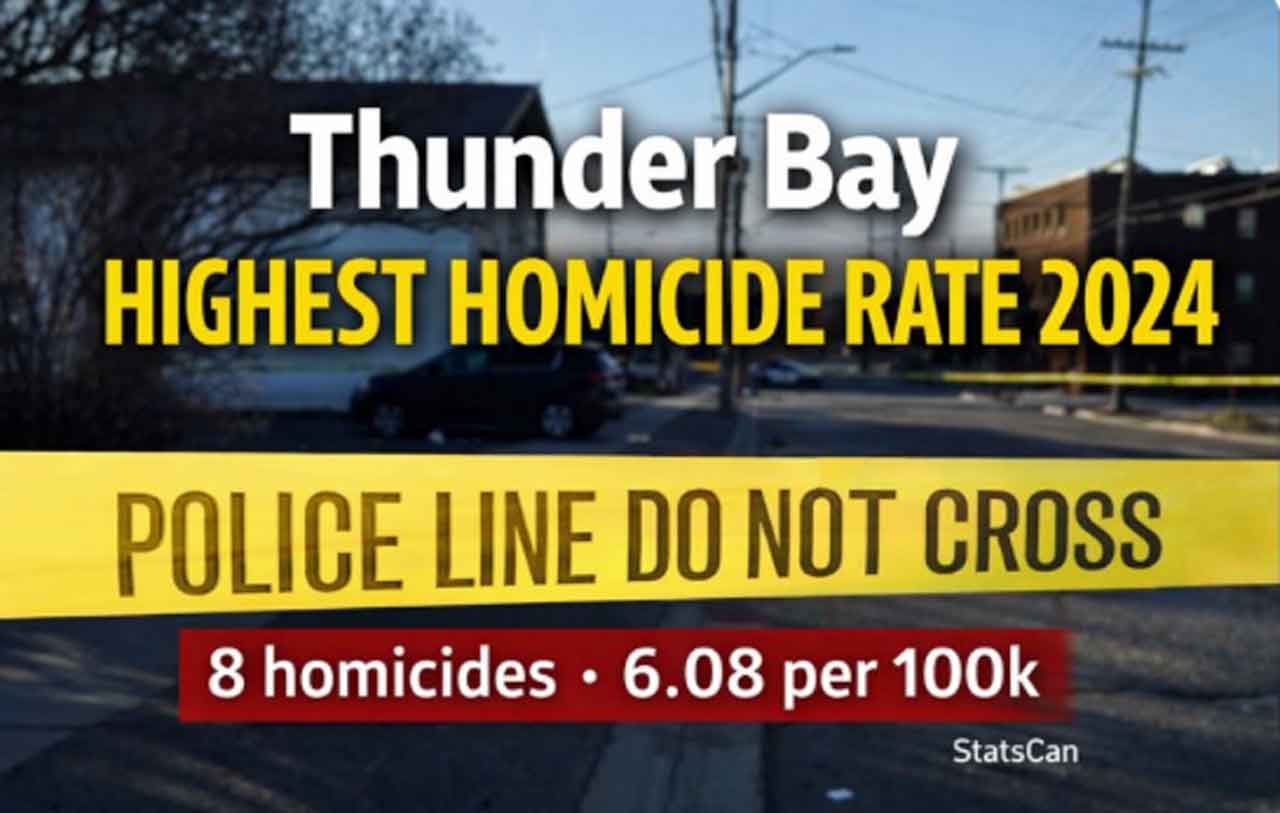
Against that national decline, Thunder Bay recorded eight homicides in 2024—which translated into a homicide rate of 6.08 per 100,000, the highest among Canada’s census metropolitan areas (CMAs).
This is not new territory for Thunder Bay. From 1995-2020 Thunder Bay held the dubious title of “Murder Capital of Canada”. The city has now held this mantle for 2022, 2023 and 2024.
It’s important to be clear about what “per capita” means in a community Thunder Bay’s size: with a CMA population of about 131,594, a change of just a few cases can swing the rate dramatically.
That volatility doesn’t make the problem any less real—it does mean residents can see Thunder Bay “top the list” even when the raw number of homicides remains in single digits.
Violence in Thunder Bay isn’t just a homicide story
Homicide is often treated as the “bottom line” indicator of safety. Statistics Canada notes it accounts for about 0.1% of all police-reported violent crimes, but it remains a key metric for assessing community safety and social welfare.
In Thunder Bay, the broader violence picture helps explain why the homicide rate is so alarming. In 2024, Statistics Canada reports Thunder Bay’s Crime Severity Index (CSI) was 107.7, up 8% year-over-year, alongside a crime rate of 6,867 incidents per 100,000 people (also up 8%).
Thunder Bay Police Service data in its 2024 annual report adds local texture to that CSI number: 1,450 assaults, 266 robberies, and 188 sexual assaults/sexual offences were recorded in 2024, alongside 8,458 total Criminal Code incidents.
Why are Thunder Bay’s violence rates so high? A web of overlapping factors
There isn’t a single cause behind violent crime. But local planning documents and agency reports consistently point to a cluster of pressures that raise risk—for victimization, for conflict, and for harm.
1) The toxic drug crisis and the violence that can surround it
Thunder Bay’s Community Safety and Well-Being Plan describes an “unprecedented threat” from criminal organizations profiting from the hardships of addiction, alongside family violence and a mental health crisis.
Public health indicators line up with that concern. The Thunder Bay District Health Unit notes the district has higher rates of deaths from opioid poisoning compared with Ontario and “one of the highest rates in the province.”
A health unit social post citing 2024 figures reported 80 opioid-related deaths and a mortality rate of 69.14 per 100,000—a stark signal of how severe the local drug toxicity emergency remains.
While overdose deaths and homicides are different measures, they often share underlying drivers: a volatile unregulated drug supply, high-risk street involvement, and exploitation by organized networks.
2) Housing insecurity, homelessness, and mental health strain
Thunder Bay’s 2024 Housing Needs Assessment outlines how housing pressures intersect with vulnerability. It notes 953 people on the “By Name List” (as of January 2025) and summarizes October 2024 Point-in-Time Count results showing:
-
80% of respondents reported substance use
-
61% reported mental health issues
-
78% identified as Indigenous
-
Significant portions reported long-duration or repeated homelessness
The same report describes Thunder Bay’s role as a regional hub—attracting people from surrounding areas seeking health care, housing, and social services not available elsewhere.
When systems are overloaded, the consequences can show up on the street and in emergency calls: disputes, victimization, survival-related offences, and escalating conflict.
3) Family violence and trauma, including the legacy of systemic harm
Thunder Bay’s community safety plan explicitly references violence within families and the broader social impacts of mental health crises.
Nationally, Statistics Canada also reported a sharp rise in intimate partner homicides in 2024 (100 victims, up from 72 in 2023), with women comprising 81% of victims.
Thunder Bay’s context includes a large Indigenous population and ongoing work around reconciliation and anti-racism—issues that matter because systemic discrimination, poverty, and intergenerational trauma are repeatedly linked to elevated risks of victimization.
Statistics Canada notes Indigenous people were 30% of homicide victims nationwide in 2024 while representing about 5% of the population, and cites colonization-related factors as root causes.
4) Weapons and the reality of day-to-day enforcement
Nationally, firearms were used in 36% of homicides in 2024, with handguns the most common firearm type in firearm-related homicides.
Locally, TBPS reported a sharp increase in seizures: 267 authentic firearms seized in 2024, up from 139 in 2023.
Seizures can reflect both enforcement activity and availability, but either way the implication for officer and public safety is clear: more encounters where a weapon may be present.
What Thunder Bay can do with this data
The uncomfortable headline—“highest homicide rate”—should not become a label for the city. It should be a prompt for coordinated action.
Thunder Bay’s own Community Safety and Well-Being Plan stresses “upstream” approaches: reducing poverty, improving access to housing and education, and building cross-sector partnerships so police aren’t left as the default response to health and social crises.
Based on what the data is signaling, the most credible path forward is multi-track:
-
Housing-first and supportive housing expansion, paired with mental health supports
-
Addictions treatment and harm reduction scaled to match the level of need
-
Focused disruption of organized criminal networks exploiting addiction
-
Family violence prevention and survivor supports
-
Violence interruption and youth prevention in the highest-risk corridors
Thunder Bay’s homicide rate in 2024 is a warning light.
The reasons behind it—housing strain, a toxic drug supply, family violence, and systemic inequities—are solvable only with sustained, joined-up investment. The numbers tell us where to look; the next step is choosing to act.
Final Sentence: Thunder Bay leads Canada’s 2024 homicide rate. Housing strain, drugs and weapons help explain it all!?