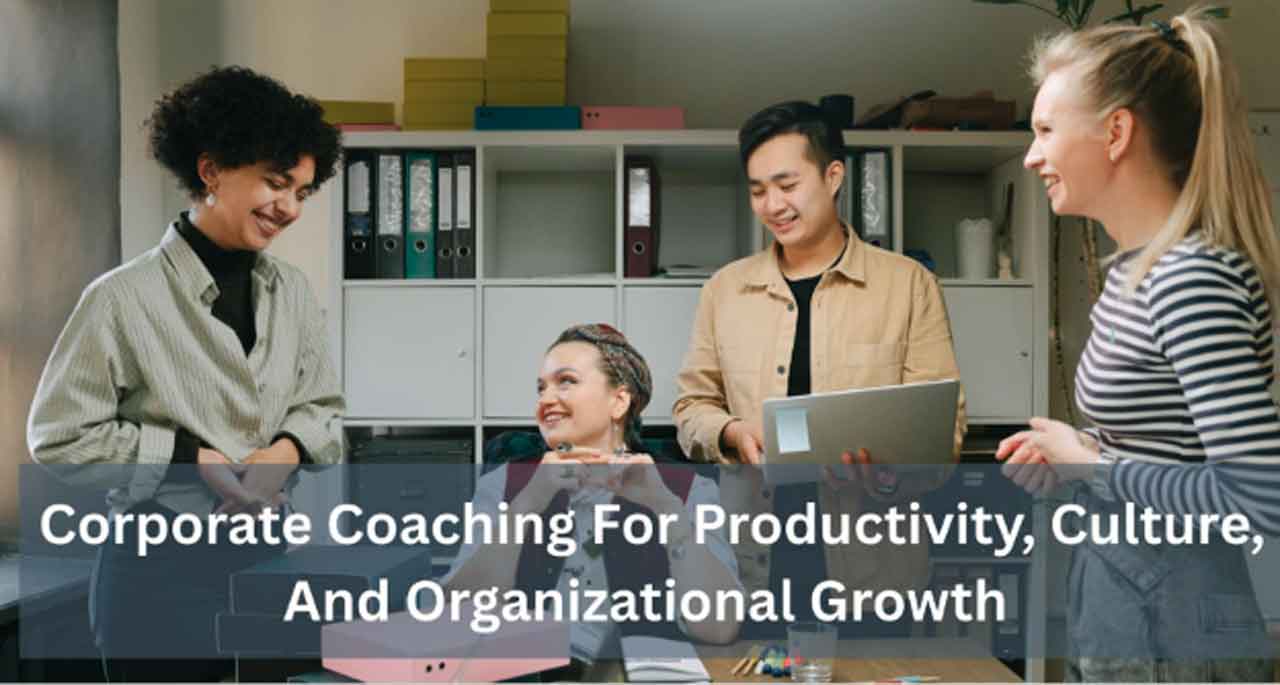
In the current, very dynamic corporate world, organizations are not only confronted with operational challenges; they also need to cultivate an effective culture that enhances productivity and leads their teams through transformation.
This is exactly where customized corporate coaching comes in.
By professionally consulting a competent corporate coach, businesses can close the gap between strategy and reality. Moreover, considering employee growth, businesses can tap into untapped potential, reduce stress levels, and align their internal culture with their strategic objectives. In the long run, this alignment creates a culture where teams are empowered, communication improves, and performance becomes sustainable.
The remainder of this paper examines five major ways through which corporate coaching can facilitate productivity, culture, and organizational development.

1. Improve Productivity
Do people who are responsible for the most important tasks, like managing the entire organization, ever second-guess themselves?
With the help of a corporate coach, they can also get a partner along with some constructive advice. This assists leaders and their staff in performing their duties and simplifying work.
A corporate coach can help people identify bottlenecks, spend time and energy more wisely, and develop habits that help maintain steady performance. Moreover, they can minimize distractions and exhaustion by providing training to boost mindset, resilience, and clarity.
Consequently, productivity not only goes up in the short term but also in a manner that can be sustained. Teams are more concentrated, responsive, and capable of achieving results.
2. Develop Good and Coordinated Organizational Culture
Culture is the commonality of habits, beliefs, and behaviors within an organization.
Considering that, coaching is critical to developing company culture, as it enables everyone, including senior leaders and frontline employees, to learn how their actions impact the broader environment.
One-on-one or team coaching sessions help people reflect on their role in the culture, how communication channels work, and where they need improvement.
Furthermore, coaching fosters emotional intelligence, presence of mind, and purpose, helping teams appear more aligned and cooperative. When this occurs, greater alignment within the departments, trust, and a positive culture begin to take hold. This culture promotes productivity, innovativeness, and sustained development.
3. Empower Organizational Development through Leadership and Teams
Sustainable growth requires both strategy and the willingness of leadership and their teams to implement it.
Corporate coaching helps leaders develop traits such as self-awareness, improved decision-making, and clearer communication. These traits develop more robust leadership capabilities and enable teams to be independent and accountable.
Coaching also helps teams manage change, resolve conflict, and work towards common objectives. When leadership and teamwork become better, the organization becomes more responsive and agile. What will be achieved is the capacity to respond to market changes and scale more effectively to accommodate growth without exhausting critical individuals.
4. Integrate Resilience, Change Management, and Communication Skills
Resilience and communication are important in a dynamic environment. Coaching helps individuals develop realistic coping strategies for stress, think clearly, and remain stable during the transitional period. People are taught to stop, think, and act, not to react.
These individuals develop better listening, open-minded dialogue, and more effective feedback-taking behaviors. Such practices improve how teams navigate change and maintain performance despite uncertainties.
As organizations change structure, market conditions, or strategy, coaching can ensure people are in tune with one another, linked, and able to comfortably take on new roles.
5. Calculate Effect and Producing Sustainable Behavioral Change
The emphasis on measurable outcomes and sustainable change is also a strength of corporate coaching. Instead of merely providing a training experience, coaching offers a more individualized process that monitors progress, recognizes challenges, and supports new behaviors.
Organizations can establish objectives in terms of productivity, culture, and growth, after which they can engage a coach to track the objectives, assess progress, and devise a new direction.
In the long run, this strategy instills new behaviors, contributes to the ongoing improvement process, and makes coaching results more lasting. The leaders and teams are left to work in a new dimension where high performance, a healthy culture, and growth are the order of the day.
Final Thoughts
In the modern workplace, coaching is a must to understand what the younger generation requires to produce the best results. It is an interesting avenue for organizations to enhance productivity, influence culture, and promote growth.
Companies can transition between intention and action by undertaking a coaching process that empowers individuals, teams, and leadership.
The relevance and resonance of coaching is bound to achieve results through its tailoring to all levels of an organization. New habits are formed, and old ones are substituted; the teams get more cohesive, the leaders become more assured, and the organization is more apt to succeed. This makes corporate coaching not only about investing in skills, but also in long-term health and stability of the whole business.