The world’s manufacturing productivity has come to a standstill, with just a 2% growth rate every year, while disorganisation in operational monitoring costs businesses over $1 trillion annually, according to the World Economic Forum 2024 report. In this age where factories worldwide struggle with outdated processes, a new digital dashboard is bringing a positive approach to this scenario. Developed by a Business Intelligence (BI) expert, Shrutika Mokashi, this web-based solution replaces outdated, paper-based systems with a web-based tool, offering more efficient global manufacturing solutions. With factories in more than 150 nations still depending on manual tracking, Shrutika’s work is guiding industries to operate on a global scale.
The manufacturing industry worldwide faces multiple challenges that slow down growth and increase costs. One major problem is the dependency on paper-based records, a system still followed in 60% of mid-sized factories, per the 2023 McKinsey study. This leads to delays in procuring data, with response times often stretching to days, and errors occurring due to human input. These mistakes can cost large on operational budgets. Moreover, the retail and commercial sectors struggle with uncertain production tracking, making it difficult to meet demand spikes and manage supply chains efficiently. Environmental concerns, notably deforestation and the documentation industry’s contribution to global carbon emissions (according to the United Nations Environment Programme), add complexity. O.C. Tanner’s 2023 Global Culture Report, surveying over 36,000 employees (including 2,792 in manufacturing), revealed that 47% of manufacturing managers reported increased responsibilities post-COVID-19. Furthermore, 31% of manufacturing workers noticed stress in their direct managers, underscoring the pressure on these roles. These multifaceted challenges necessitate a new approach, which Shrutika’s project is initiating on a global level.
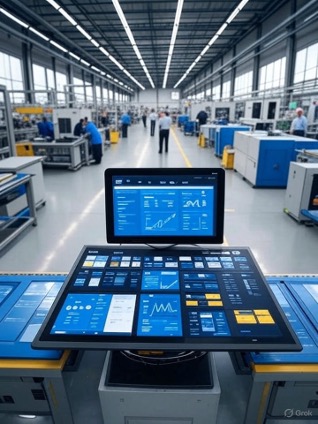
Shrutika introduced a web-based dashboard into this complex operational space, where her solution aimed to eliminate paper-based processes while optimising factory processes. The development process began with a thorough analysis of production team requirements, revealing critical challenges such as slow data access and scattered monitoring. She collaborated with offshore engineering teams to develop a system capable of extracting live data from varied sources. This method leverages Apache Kafka as the support system for streaming factory data from disparate sources. By connecting machinery, ERP systems, and IoT devices to Kafka pipelines, the system ingests and processes millions of events per day with sub-second latency.
Once the data is consumed, Azure Stream Analytics processes it in real time, identifying bottlenecks, anomalies, or operational lags, while providing actionable insights to line managers and decision-makers. This integration reduces latency by up to 80% compared to batch-based reporting models and significantly improves responsiveness. The dashboard’s predictive analysis also adjusts dynamically as volumes scale, with the help of Azure’s auto-scaling cloud infrastructure.
Beyond the factory, the dashboard significantly improves operations, as in retail, it highly increases stock prediction accuracy with Azure integration, minimizing supply chain disruptions and empty shelves. For commercial operations, real-time order fill rate tracking improves customer satisfaction through timely deliveries, which is vital given substantial retail losses due to stockouts. Moreover, Shrutika’s implementation of sustainability measures significantly reduced paper consumption by approximately 70%, aligning with global initiatives focused on lowering carbon emissions. This action supports wider societal goals, including the New York Declaration on Forests (2014), which aims to halve deforestation by 2020 and end it by 2030.
Shrutika’s dashboard design targets the world market by advocating scalability across diverse industries, including automotive and consumer goods. Its modular features allow for customization by local teams, where she aimed for a universally applicable tool, stating, “I wanted this tool to grow beyond one setting, to be adaptable enough to serve a local shop floor in Vietnam or a robotics plant in Germany,” emphasizing its potential to address widespread inefficiencies.
The system’s Kafka-powered messaging bus also promotes inter-factory communication, enabling global manufacturers to share real-time metrics across continents. The capacity for collaboration holds the potential to upgrade commercial supply chains, allowing them to adapt more readily to the ever-changing consumer demands and economic fluctuations. Shrutika’s approach also considers the workforce, whereby automating routine monitoring, the dashboard frees up staff to focus on creative problem-solving, a shift that could uplift job satisfaction in the industry. Societally, this efficiency gain supports better livelihoods, as factories can redirect savings to community initiatives or fair wages. Shrutika’s offshore training initiatives have reached over 500 workers in Southeast Asia and Africa, democratizing access to cutting-edge data tools.
At its technical core, the dashboard handles up to 10 terabytes of daily production data. Kafka’s distributed event streaming ensures resilience and scalability, while Azure’s native services such as Event Hubs, Stream Analytics, and Synapse enable advanced analytics on the fly. Within manufacturing, a 2024 Forbes article highlights the substantial annual cost of unplanned downtime for U.S. manufacturers, amounting to roughly $50 billion. Notably, the system features a self-tuning mechanism that autonomously adapts to usage patterns, optimizing performance and potentially saving factory tech teams approximately 200 hours of yearly maintenance per site.
On the retail front, the dashboard’s real-time order fill rate tracking, collaborating with e-commerce platforms, lowers stockout losses in pilot regions. On the commercial level, the tool’s web app interface, built with scalable cloud architecture, supports 1,000 concurrent users without lag, a stark contrast to legacy systems that crash under half that load. This scalability positions it as a backbone for multinational corporations managing diverse production sites.
The environmental benefits are tangible, as reducing paper use through automated dashboards can significantly lower operational waste, with estimates showing that digital documentation can save thousands of sheets per employee annually, equivalent to several tons of paper across large-scale operations. According to the EPA’s Greenhouse Gas Equivalencies Calculator, substantial paper reduction can meaningfully cut emissions, comparable in scale to taking thousands of cars off the road, depending on adoption levels. A 2024 NielsenIQ report notes that 70% of global consumers prioritize sustainable livelihood. This signals a positive step towards eco-conscious purchasing. Furthermore, incorporating data governance tools using Azure Purview and quality control checklists, can reduce process errors and improve traceability. The U.S. Consumer Product Safety Commission (CPSC) estimates that product-related damages cost the economy over $1 trillion annually, highlighting the critical nature of minimizing recalls and defects through better data practices.
For society, the dashboard’s efficiency could generate billions in savings for the manufacturing industry, potentially funding education or healthcare initiatives in regions such as India and Mexico. Its open-source nature encourages a global developer community to expand its capabilities, promoting standardized efficiency on a global level. Shrutika’s collaboration with offshore teams disseminates technical expertise, enabling over 500 workers in developing economies to utilize comparable tools, thereby strengthening local economies. This advancement in technical capabilities across nations has the potential to change how industries prioritize both profitability and environmental well-being, establishing a benchmark for future innovation.
This dashboard is a pivotal part of factory operations, with its worldwide influence set for crucial expansion. By integrating Apache Kafka and Azure real-time analytics, it delivers unmatched speed, scalability, and environmental responsibility. Its adaptable design allows for implementation in both small and large factories, promoting a more equitable competitive environment across industries with differing levels of technological access. The environmental benefits, notably the decrease in paper usage, contribute to an eco-friendly and sustainable future, as per global climate objectives and consumer preferences. As industries experience stricter regulations and limited resources, this project’s adaptable, open, and efficient structure provides a model for flexibility. Its impact has the potential to bring forward an upswing of data-centric tools, aiding economic growth while alleviating societal burdens, thereby supporting factories everywhere to prosper without harming the environment.