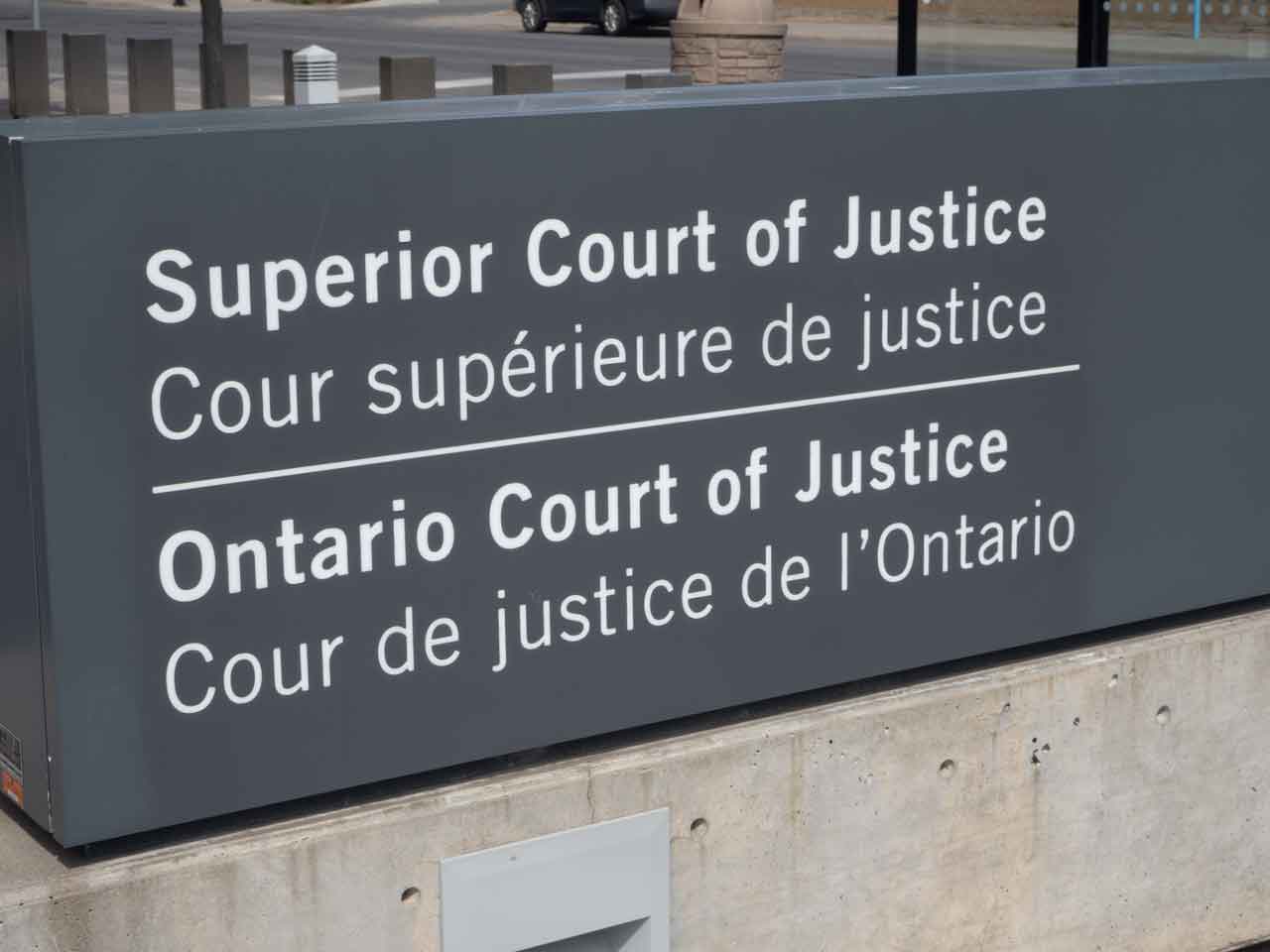
THUNDER BAY, ON – Derek Kenney faced a series of sexual assault charges stemming from incidents in 2003 and 2004 and again in 2020. Kenney has now been sentenced for those crimes that he was convicted of in 2024.
In a recent decision handed down on June 4, 2025, at the Ontario Superior Court of Justice, Derek Kenney was sentenced to 13 years of incarceration for four counts of sexual assault against four separate complainants.
Madam Justice T.J. Nieckarz delivered the sentencing, following her guilty verdict against Mr. Kenney on October 28, 2024, for offences contrary to s. 271 of the Criminal Code, R.S.C., 1985, c. C-46.
This sentence, which includes various ancillary orders, underscores the court’s commitment to denouncing unlawful conduct and deterring similar crimes, while also acknowledging the profound and lasting impact on victims.
The Offences and Their Impact
The court heard details of four distinct sexual assaults committed by Mr. Kenney:
• Count #1 – First Victim: In October 2020, K.D., an intimate partner, was drugged by Mr. Kenney with “mushrooms” in her tea, causing her to lose consciousness. While she was unconscious, Mr. Kenney engaged in anal intercourse with her, painted a pumpkin, and added writing to her bottom, which he photographed. This was found to have vitiated her consent.
The victim of this attack now convicted sex offender reported deep emotional, physical, and economic hardship, ongoing fear, paranoia, and anxiety, a shattered sense of safety, and struggles in relationships. She has been in costly counselling since May 2021 and has experienced loss of income.
• Count #2 – Second Victim: In 2003/2004, a woman who had just graduated high school and was alone in Thunder Bay, was drugged by Mr. Kenney with tea, causing her to feel “high” and pass out. She awoke to find her clothes partially removed, her breasts sore, and her legs uncomfortable, with blood and a white substance on the bed and her underwear disheveled and torn.
The court was certain a sexual assault occurred, though not definitively sexual intercourse. The victim of the assault described carrying a “wound” that impacted relationships, caused job loss due to focus struggles, and led to fear, nightmares, anxiety, disassociation, and depression for over a decade.
She gained weight as a protective mechanism and underwent extensive therapy.
• Count #3 – Third Victim: In late August/early September 2020, during a back massage offered by Mr. Kenney exploited her past sexual abuse trauma. He asked her to call him “daddy” and pretend he was her step-father, then pinned her down and had sexual intercourse while repeating statements about her step-father, claiming it would “heal her trauma”.
This victim, according to the transcript of the Judge’s sentencing report, expressed “not right now” and concern for her three young children downstairs, leading her to let him “do what he wanted”.
The victim experienced anxiety, isolation, and depression, with frequent nightmares and difficulty sleeping. She struggles with trust in relationships, cries frequently, and suffered physical symptoms like vomiting and hair loss due to intense anxiety. She fears for her children and has moved homes, installing security cameras.
• Count #4 – Victim 4: In November 2017, when this individual was 17-and-a-half, Mr. Kenney, whom she had a casual relationship with, told her to take her pants off, which she twice refused.
He then grabbed her waist, removed her pants, touched her vagina, forcefully put his penis in her mouth, and had intercourse until ejaculating on her stomach and breasts.
He also grabbed her hair and slapped her face. This victim reported a significant impact on her life, suffering depression and anxiety for years, leading to counselling. Her sense of safety and trust was shattered, causing turbulent relationships, challenges with male medical personnel, and constant fatigue and headaches from reliving the trauma.
Offender Profile and Sentencing Principles
Mr. Kenney is a 46-year-old musician who was adopted at six months and lived most of his life in Thunder Bay, though he relocated due to a social media “frenzy” surrounding the allegations.
He has a 16-year-old child and maintains good relationships with various ex-partners. He suffers from Tourette’s Syndrome, ADHD, and obsessive-compulsive disorder. Despite not completing grade ten, he enrolled in a Music Therapy program.
Six character letters were submitted on his behalf, describing him as a loving, supportive, patient, kind partner, selfless, compassionate, of integrity, responsible, hardworking, and an attentive father.
A childhood friend noted his support with Tourette’s and other anxieties, describing him as “nothing but kind and sweet”. Another friend believed he would use any sentence for personal growth, suggesting a “strong prospect for rehabilitation”.
However, the pre-sentence report writer found these descriptions “incongruent with the nature of the offences”.
The court acknowledged these references but noted that good character evidence often holds low probative value in sexual assault cases because such offenses are typically committed in secret.
Mr. Kenney has one prior conviction for sexual assault from May 2004, for which he received a six-month conditional sentence, and a fail to appear.
He has maintained his innocence regarding the current charges. The court treated his dated criminal record as neutral.
Madam Justice Nieckarz was guided by Section 718 of the Criminal Code, which outlines the fundamental purpose of sentencing: to protect society and contribute to respect for the law and a just society.
Key objectives include denunciation of unlawful conduct and harm done to victims, deterrence of offenders, separation of offenders from society when necessary, and rehabilitation. For sexual offenses, denunciation and deterrence are primary considerations.
The sentence must also be proportionate to the gravity of the offence and the offender’s responsibility. Aggravating factors increase sentence severity, while mitigating factors moderate it.
Court’s Analysis and Decision
The Crown argued for a global sentence of 15 years of custody, applying the totality principle to a starting point of five years per count. The Defence sought a sentence of two years less a day with three years’ probation, arguing that a lengthy penitentiary sentence would “crush the offender” and hinder rehabilitation.
The court adopted the range of three to five years for each instance of sexual assault involving forced penetration, as established in R. v. A.J.K.. The court found that Mr. Kenney’s community service and parenthood were mitigating but not “highly mitigating” enough to warrant a departure from this range.
Aggravating factors for these offences included:
• Intimate partner relationships with two of his victims..
• Drugging of two of his victims to render them unconscious, implying planning for another of his victims.
• The presence of one of his victim’s children and Mr. Kenney’s comment raising safety concerns for them.
• Significant psychological trauma suffered by all four women.
• The high vulnerability of three of his victims, including one whose prior sexual abuse which Mr. Kenney exploited.
• Gratuitous violence against a victim including slapping and hair pulling.
• Photographing one of his victims without her knowledge or consent.
• The Indigenous status of one of his victims recognizing increased vulnerabilities for Indigenous female victims.
Considering these factors, the court determined individual sentences before applying totality: five years for attacking one victim (due to intimate partner relationship, drugging, and forced anal intercourse), four years for the 17 year old victim (due to young age, vulnerability, drugging, and assault causing physical injury), five years for another of his victims. (due to intimate partner relationship, exploitation of trauma, children’s presence, and Indigenous status), and four years for another victim (due to vulnerabilities, physical violence, and nature of assaults).
This totaled 18 years.
The court ruled that consecutive sentences were appropriate because the offenses were “separate events, that happened to separate people, on separate dates, some of which were years apart,” and not part of a “single criminal adventure”.
Applying the totality principle, which ensures the combined sentence does not “unduly long or harsh” and preserves some hope for rehabilitation, the court reduced the overall sentence from 18 years to 13 years of incarceration. This, the court concluded, is a “significant custodial sentence” that reflects the crimes’ seriousness while still allowing for the prospect of rehabilitation.
Final Sentence and Orders
Mr. Kenney’s 13-year sentence is allocated as follows: 3.5 years for First Victim., 3.0 years for second victim, 3.5 years for third victim, and 3.0 years for the fourth victim of his behaviours.
In addition to the custodial sentence, Mr. Kenney is subjected to several ancillary orders:
• A lifetime weapons prohibition.
• A DNA order, requiring him to submit a sample.
• A lifetime order to comply with the Sex Offender Information Registration Act (SOIRA), as the offenses demonstrate a pattern of behavior indicating an increased risk of reoffending sexually.
• An order prohibiting him from communicating, directly or indirectly, with any of the four victims during his custodial period.
The victim fine surcharge was waived due to Mr. Kenney’s limited financial means.
Are there other victims out there who have not yet come forward? Contact police!